AfD in NRW Continues Election Assembly Despite Criticism from AfD Leadership
The AfD's North Rhine-Westphalia (NRW) branch is proceeding with its election assembly for the 2027 state elections, rejecting a call from party leader Alice Weidel to halt the proceedings.
Intelligence analysis by Gemini 2.5 Flash Lite
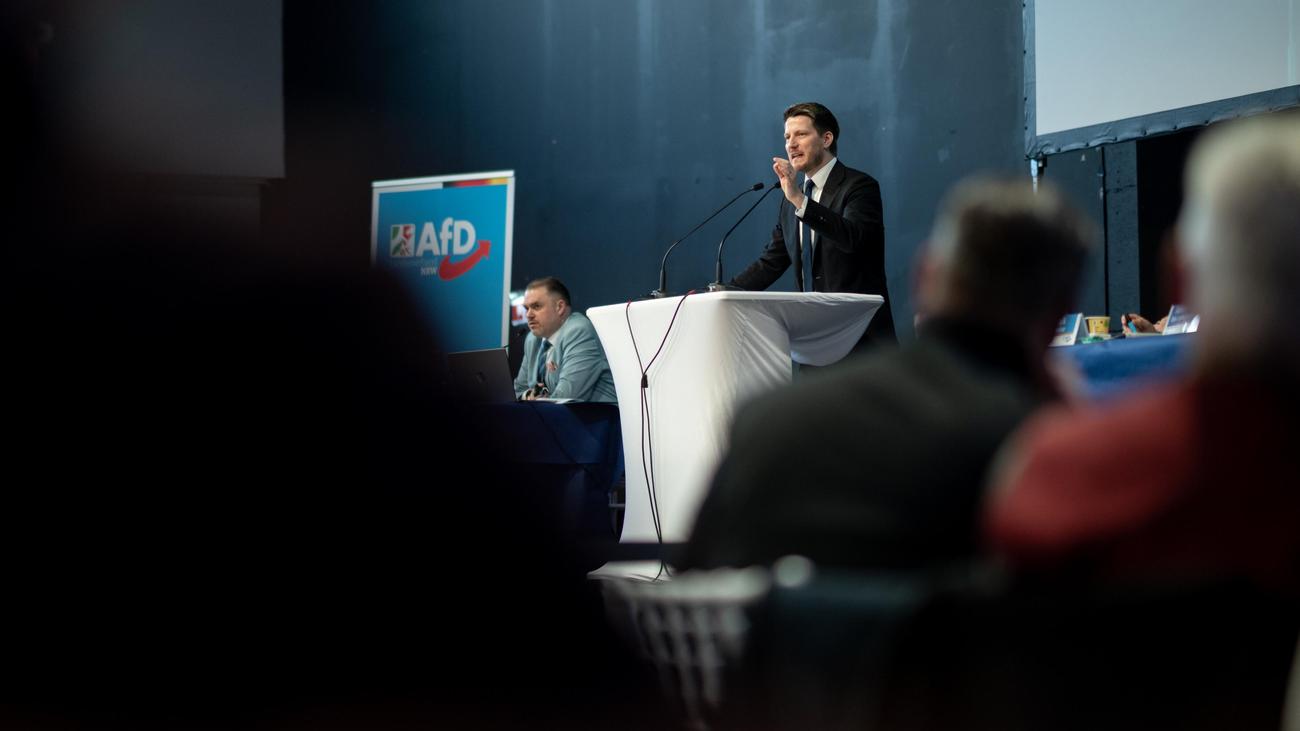
Martin Vincentz, head of the AfD NRW, has defied the party's federal leadership, specifically Alice Weidel, by refusing to cancel the ongoing candidate nomination assembly. He argues there is no legal basis for the federal board to halt the process and suggests the leadership's concerns are politically motivated, aiming to influence the list's composition rather than address legal unc…
Imagine a school club is picking its leaders for next year. The main school leaders told the club, "Stop picking! We think you're doing it wrong." But the club leader said, "No, we're following the rules, and you just want to pick different people, not fix any real problems. We're going to finish picking our leaders."
Analysis
Defiance of Federal Leadership
The chairman of the AfD's North Rhine-Westphalia (NRW) state association, Martin Vincentz, has publicly rejected a directive from the party's federal board and its co-leader, Alice Weidel, to cease the ongoing state election assembly. Vincentz's response, penned in a letter to Weidel, expresses surprise that alleged legal uncertainties are now being cited as a reason to halt the candidate nomination process, especially after what he termed "failed sabotage attempts by the 'Operation Filibuster' group." This indicates a deep rift between the regional and federal wings of the party, with the NRW branch asserting its autonomy.
Allegations of Political Motivation
Vincentz's letter directly challenges the legitimacy of the federal leadership's demand. He argues that if the federal board truly believed the assembly's proceedings were legally flawed, they would not be attempting to negotiate the composition of the list. "Anyone who wants to negotiate over the composition of a list evidently considers it valid themselves; one does not negotiate over the outcome of a supposedly illegal election," Vincentz wrote. This suggests his interpretation that the leadership's true aim is not to ensure legal compliance but to influence the selection of candidates for the 2027 state parliamentary elections, potentially sidelining certain factions or individuals.
Legal and Procedural Arguments
Vincentz further asserts that there is no legal foundation for the federal board to unilaterally terminate a state-level assembly. He characterizes Weidel's letter as a purely political statement rather than a legally binding order. According to Vincentz, the assembly, which commenced on July 9, 2026, was properly adjourned and is scheduled to reconvene on July 17, 2026. He contends that a meeting already in progress cannot legally be stopped, meaning the state leadership would be unable to comply with the federal directive even if they wished to. This legalistic stance underscores the NRW branch's determination to proceed on its own terms, setting the stage for a potential internal party dispute.
Key points
- The AfD's North Rhine-Westphalia (NRW) branch is continuing its election assembly despite a directive from party leader Alice Weidel to halt it.
- NRW chairman Martin Vincentz rejected the call, stating there is no legal basis for the federal board to stop the assembly.
- Vincentz suggested the federal leadership's concerns are politically motivated, aiming to influence candidate selection rather than address legal issues.
- He argued that a legally convened assembly, once adjourned, cannot be legally terminated.
- The assembly is scheduled to continue on July 17, 2026.
If the NRW AfD successfully navigates this internal dispute and proceeds with its candidate selection, it could emerge with a unified and determined slate for the 2027 elections. This would allow them to focus their energy on campaigning and potentially strengthen their position in a key German state.
The continued defiance of the federal leadership risks escalating the internal conflict, potentially leading to disciplinary actions against the NRW branch or key figures. This could fracture the party, alienate voters, and significantly weaken the AfD's electoral prospects in North Rhine-Westphalia.