AI sell-off deepens as chip stocks slump in market retreat - business live
An AI-driven sell-off hit chip stocks after a report on China's mass production of DUV chipmaking tools, while Barclays posted a 17% rise in first-half profit and Unilever warned prices could rise.
Intelligence analysis by Llama
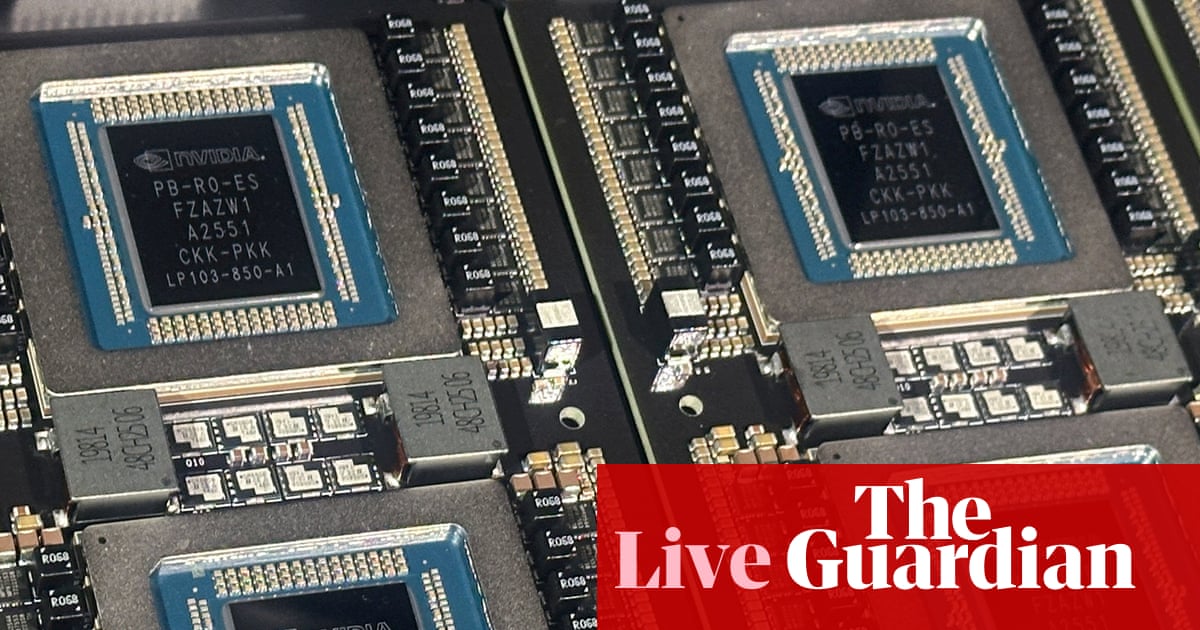
Chip stocks slumped after a report that China has started mass-producing DUV chipmaking tools, deepening an AI sell-off. Barclays posted 17% profit growth and announced a £1bn buyback, while Unilever flagged potential price increases later in 2026 as commodity costs bite.
Tech companies are like kids trading the coolest robot toys. China just said it can build its own robot-making machines, so everyone got scared the special robot makers might lose their magic. Meanwhile, bank Barclays made lots of money and will give some back to its owners, and soap like Dove might cost more soon because ingredients got pricier.
Analysis
China's DUV Gambit Spooks the Tape
The trigger for the latest leg of the AI sell-off was a report from The Information that China has begun mass production of homegrown deep ultraviolet (DUV) chipmaking tools, according to the article. The market read this as a direct challenge to the global chipmaking equipment leaders who have so far dominated the supply chain for advanced semiconductors. Jing Jie Yu, an equity analyst at Morningstar, argued the reaction was "largely a knee-jerk reaction and overdone," but acknowledged investors are worried that China's progress could "threaten the competitive position of global chipmaking and chip equipment leaders." The fear is less about today's revenue and more about the long-term moat: if China can produce DUV tools at scale, the pricing power and margins of incumbents from the US, Netherlands, and Japan come under structural pressure.
Barclays Prints a Beat but Faces Political Heat
Barclays reported a 17% rise in pre-tax profit to £6.1bn for the first half of 2026, beating analyst expectations of £5.9bn. The bank's equities traders generated £1.26bn, up 45% year-on-year, and investment banking fees rose 32% to £747m. Even with higher credit impairment charges of £1.4bn, the bank announced a £1bn share buyback and raised its full-year income target. Matt Britzman, senior equity analyst at Hargreaves Lansdown, called the strategy "moving in the right direction" but noted the bank still has "more to prove against the scale of its US rivals." The TUC seized on the numbers to demand a higher bank surcharge, with general secretary Paul Nowak arguing that "big banks like Barclays are raking it in while working people and local businesses are struggling" amid rising energy costs linked to the war in Iran.
Inflation Watch: Unilever's Price Warning
Consumer goods giant Unilever offered a more sobering signal on the cost-of-living front, warning that "underlying price growth to accelerate in the second half as commodity-driven pricing continues to land in market." The FTSE 100 group reported better-than-expected second-quarter underlying sales up 5.8%, helped by both higher volumes and prices, but the guidance suggests more sticker shock for shoppers. Chief executive Fernando Fernandez called it "the best volume quarter at Unilever in over a decade" while flagging macroeconomic uncertainty. With oil prices volatile (Brent crude down 2.7% at $85.95 a barrel) and the war in Iran cited as a risk to energy bills, the story threads together corporate earnings, geopolitics, and household budgets in a single morning's tape.
Key points
- Chip stocks slumped after a report that China began mass production of homegrown DUV chipmaking tools, deepening the AI sell-off
- Barclays posted a 17% rise in first-half pre-tax profit to £6.1bn, beating forecasts, and announced a £1bn share buyback
- Equities trading revenue at Barclays jumped 45% to £1.26bn while investment banking fees rose 32% to £747m
- Unilever warned that underlying price growth will accelerate in H2 2026 as commodity-driven pricing feeds through
- Brent crude fell 2.7% to $85.95 a barrel, while the TUC called for higher bank taxes on Barclays-style profits
If China's DUV progress turns out to be more limited than feared, the chip sell-off could prove a buying opportunity, with Morningstar's Jing Jie Yu describing the move as a "knee-jerk reaction and overdone." Barclays' strong results, including a £1bn buyback and raised full-year targets, point to continued strength in UK banking even amid macro uncertainty.
If China genuinely scales DUV production, the competitive position of global chipmaking equipment leaders could erode over time, pressuring margins and valuations across the sector. Unilever's warning of accelerating price growth, combined with Iran-linked energy risks, points to renewed inflationary pressure on households, while the TUC's call for higher bank taxes signals political friction ahead.
Market signals
- BARC Barclays reported a 17% rise in first-half pre-tax profit to £6.1bn, beat analyst forecasts, and announced a £1bn share buyback alongside a raised full-year income target.
- OIL The article reports Brent crude down 2.7% to $85.95 a barrel in the session, reflecting easing oil prices despite ongoing Iran conflict risk.
AI-generated analysis of potential market relevance. Not financial advice.