At least $983,000 lost since January to lucky draw scams that demand fees to release ‘winnings’
Singaporean victims have lost at least $983,000 across 254 cases since January to lucky draw scams, where they are tricked into paying various "fees" to claim non-existent prizes.
Intelligence analysis by Gemini 2.5 Flash
Scammers are luring individuals through social media, often impersonating influencers or banks, to participate in fake quizzes or lottery promotions. Victims are then told they've won a prize but must pay fabricated processing or administrative fees, only realizing they've been defrauded when no winnings materialize.
Imagine someone tells you you've won a super cool toy, but to get it, you first have to pay a small fee for 'delivery' or 'paperwork.' You pay the money, but the toy never arrives, and the person disappears. That's what's happening to people in Singapore, but with real money and fake prizes, making them lose a lot of cash.
Analysis
The Modus Operandi of Lucky Draw Scams
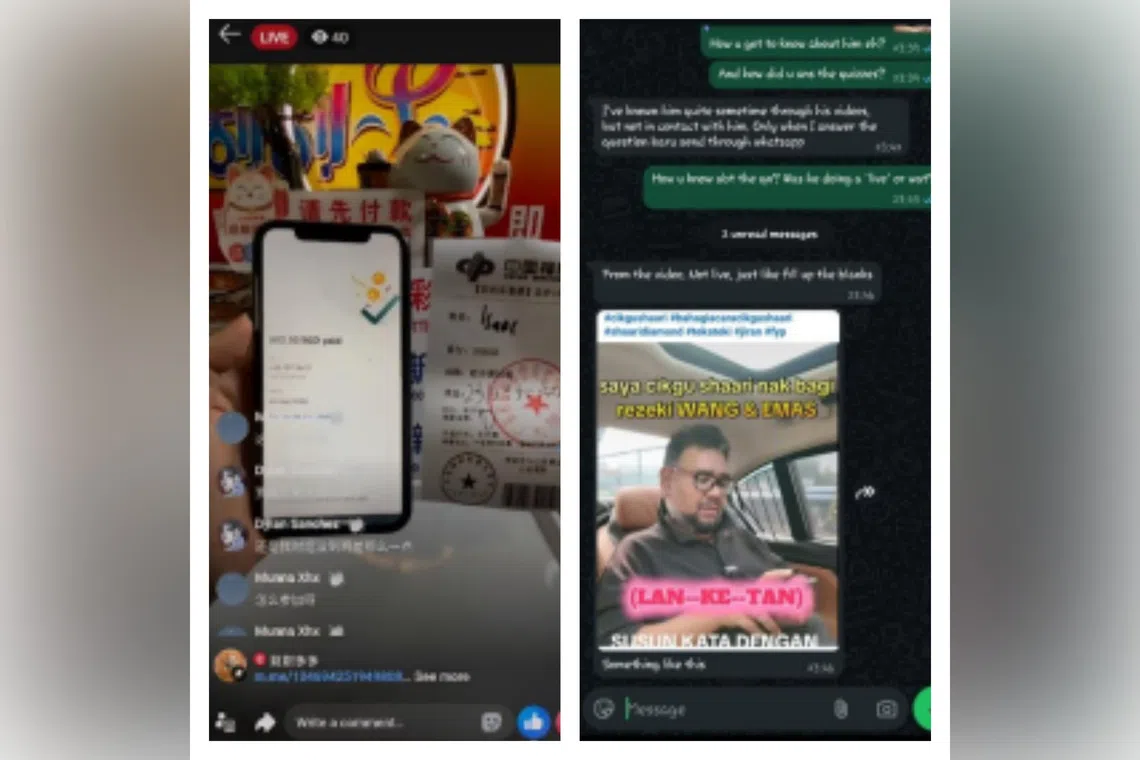
Lucky draw scams in Singapore have evolved, employing sophisticated social engineering tactics to defraud victims. One prevalent variant involves scammers impersonating popular Malaysian influencers on platforms like Facebook, inviting the public to participate in quizzes with the promise of cash prizes. Once victims engage, they are directed to WhatsApp, informed of their 'win,' and then pressured to pay a series of fabricated charges, such as processing or administrative fees. In a further layer of deception, a second scammer might pose as a representative from a reputable banking group, like Maybank, demanding additional transfers under the guise of resolving 'stuck' funds or requiring 'activation fees.'
Another common tactic involves Facebook live-streams promoting scratch cards or lottery tickets, often linked to 'China lottery' draws and operated under Chinese usernames. Victims of these bogus lotteries are similarly informed of a large cash prize and then instructed to pay 'administrative fees' via PayNow to a LiquidPay account to release their supposed winnings. The common thread in both variants is the demand for upfront payments for non-existent prizes, with victims only realizing the deception when their winnings fail to appear, the scammer's accounts vanish, or communication ceases.
Escalating Financial Toll and Public Advisory
The financial impact of these lucky draw scams is substantial, with at least $983,000 lost across 254 reported cases since January alone. This figure contributes to a broader, alarming trend of scam-related losses in Singapore, which have collectively exceeded $4 billion since 2019, with $913.1 million lost in 2025 across 37,308 cases. The police have issued a strong advisory, urging the public to exercise extreme caution. Key recommendations include refraining from transferring funds to unverified individuals, utilizing the ScamShield application, setting transaction limits on banking accounts, and promptly reporting any suspected fraudulent activity to banks and authorities. These measures are crucial in mitigating the risk of falling prey to such elaborate schemes.
Broader Implications for Digital Security
The persistence and increasing sophistication of lucky draw scams underscore a critical challenge in the digital age: maintaining public trust and security amidst a landscape rife with online fraud. The use of social media platforms and impersonation tactics highlights the need for greater digital literacy and critical thinking among users. Beyond individual vigilance, there is an ongoing imperative for platforms to enhance their security protocols and for financial institutions to implement more robust fraud detection and prevention mechanisms. The continuous evolution of scam techniques necessitates a multi-pronged approach involving public education, technological safeguards, and swift law enforcement responses to protect the community from these financially devastating criminal enterprises.
Key points
- Singaporeans have lost at least $983,000 in 254 lucky draw scam cases since January.
- Scammers impersonate influencers or promote fake 'China lottery' draws on Facebook and WhatsApp.
- Victims are tricked into paying various 'fees' (processing, administrative, activation) to claim non-existent winnings.
- Police advise against transferring funds to unknown persons, using ScamShield, setting banking limits, and reporting fraud immediately.
- Scams in Singapore have resulted in over $4 billion in losses since 2019, with $913.1 million lost in 2025 alone.
The police's proactive advisory and public awareness campaigns, including the ScamShield app, could lead to increased vigilance among Singaporeans, potentially reducing future losses and making it harder for scammers to operate effectively.
Despite warnings, the sophisticated nature of these scams, coupled with the constant evolution of tactics, suggests that many more individuals may continue to fall victim, leading to further substantial financial losses across Singapore.