New broodstock and hatchery facility at James Cook University aims to produce better Asian seabass
James Cook University's Singapore campus has launched a new broodstock and hatchery facility to advance research and train students in producing high-quality Asian seabass, a commercially important species.
Intelligence analysis by Gemini 2.5 Flash
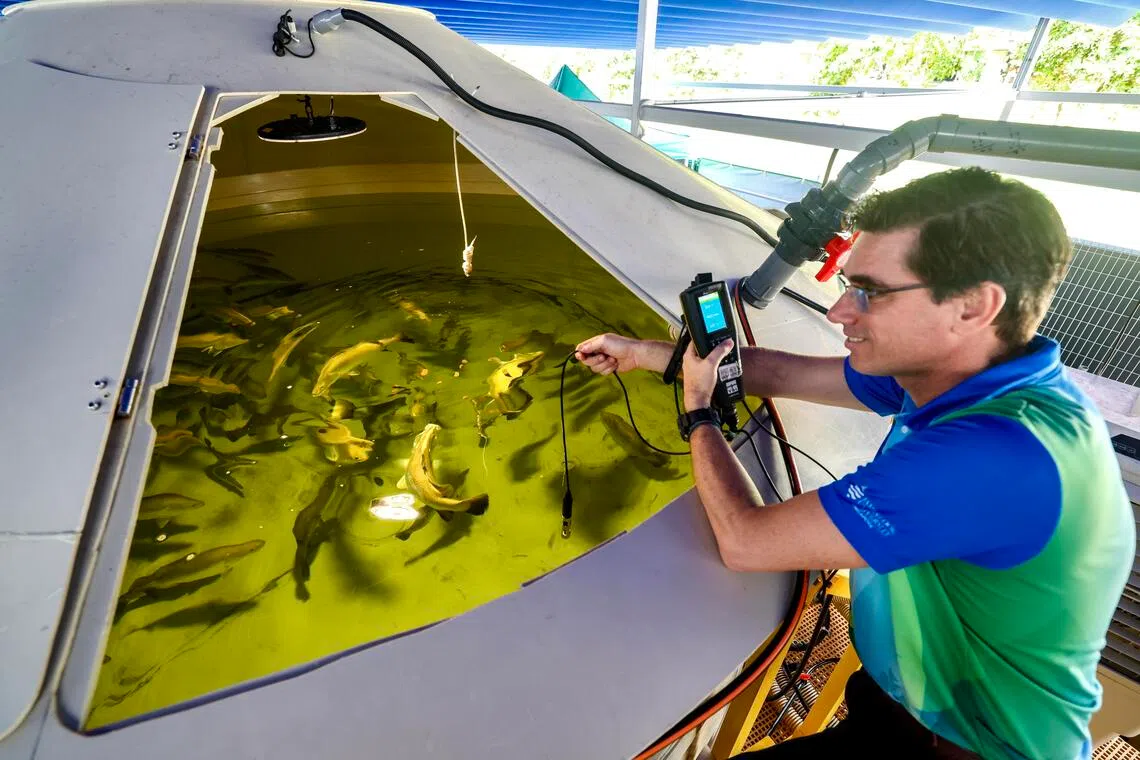
The facility, the first university-based one of its kind for Asian seabass, provides students and researchers with hands-on experience in aquaculture production, from managing breeding fish to rearing larvae. It enables selective breeding for faster-growing, healthier, and disease-resistant fish, contributing to Singapore's food resilience and developing skilled professionals for the …
Imagine a special school for fish where scientists and students learn how to make super healthy and fast-growing fish! James Cook University in Singapore just opened a new 'fish farm school' where they can control everything, from who the fish parents are to what the baby fish eat. This helps them grow stronger fish that don't get sick easily, which means more yummy fish for everyone in Singapore.
Analysis
Advancing Aquaculture Through Selective Breeding
The new broodstock and hatchery facility at James Cook University's (JCU) Singapore campus marks a significant step for the region's aquaculture industry. By providing complete control over the breeding process, from parentage to larval rearing, the facility enables researchers to conduct selective breeding programs. This is critical for developing Asian seabass (barramundi) strains that are not only faster-growing but also more resilient to common diseases, such as the scale drop disease, which currently carries a high mortality rate. Such advancements can substantially reduce the costs and risks associated with fish production, making local aquaculture more economically viable and sustainable.
This controlled environment, utilizing recirculating aquaculture systems (RAS) in 25-tonne and two-tonne tanks, allows for precise management of water quality, temperature, and biosecurity. This level of control is essential for simulating optimal breeding conditions and ensuring the health of the broodstock and fingerlings. The ability to breed fish with known parentage and genetics under these conditions provides an unparalleled platform for scientific research, directly addressing industry challenges and contributing to the overall improvement of farmed fish quality.
Unlocking Reproductive Biology Secrets
Beyond selective breeding, the JCU facility is poised to delve into the intricate reproductive biology of Asian seabass. A key area of research will be understanding and managing the species' natural sex change from male to female. Professor Dean Jerry, director at JCU’s Tropical Futures Institute, highlighted that seabass in Singapore tend to undergo this transition earlier than those in other regions like Australia. This premature shift can significantly impact breeding programs by reducing the availability of mature males for spawning, thereby limiting production efficiency.
By studying the mechanisms behind this early sex change, researchers aim to develop strategies to slow or better manage this biological process. Such insights could optimize breeding cycles, ensure a more balanced male-to-female ratio, and ultimately enhance the productivity of seabass farms. This research not only has direct implications for the commercial viability of Asian seabass farming but also contributes to a deeper scientific understanding of fish reproduction, potentially benefiting other aquaculture species in the future.
Cultivating Future Aquaculture Leaders
The facility serves a dual purpose: research and education. It offers students unparalleled hands-on experience in every aspect of aquaculture production, from managing broodstock and spawning to running hatcheries and optimizing diets. This practical training is vital for developing the next generation of skilled practitioners, a critical need for Singapore's burgeoning aquaculture sector. Employers increasingly demand graduates who can apply scientific knowledge in real-world production environments, and this facility directly addresses that demand.
With funding support from the Singapore Food Agency, the facility directly contributes to Singapore's national food resilience strategy, particularly the '30 by 30' goal of producing 30% of its nutritional needs locally by 2030. By fostering local expertise and innovation, JCU is helping to build a robust and sustainable aquaculture industry capable of meeting future food demands. The potential to explore breeding other fish species based on industry needs further underscores its long-term strategic importance.
Key points
- James Cook University Singapore launched a new broodstock and hatchery facility for Asian seabass research and training.
- It is the first university-based facility of its kind for Asian seabass, providing hands-on experience for students.
- The facility enables selective breeding to produce faster-growing, healthier, and disease-resistant fish.
- Research will focus on the reproductive biology of Asian seabass, including managing their natural sex change.
- The initiative contributes to Singapore's food resilience and aims to train skilled professionals for the aquaculture industry.
The new facility is expected to significantly boost Singapore's aquaculture capabilities, leading to the production of healthier, faster-growing, and more disease-resistant Asian seabass. This could enhance local food security, reduce reliance on imported fish, and establish Singapore as a leader in sustainable tropical aquaculture research and development.
Despite advanced research, challenges such as unforeseen disease mutations or difficulties in scaling up selective breeding programs could limit the facility's impact on overall production. The complex biological factors, like the early sex change in seabass, might prove harder to manage effectively than anticipated, potentially hindering breeding efficiency.