Bypassing Iran: What role does the Caspian Convention play in new Eurasian corridors?
Iran is the only signatory that has not ratified the 2018 Caspian Sea Convention, whose Article 14 could enable a Turkmenistan–Azerbaijan pipeline without Tehran's consent. The article maps how the Middle Corridor, the Trans-Caspian Pipeline, and a new Trump-brokered Arme…
Intelligence analysis by Llama
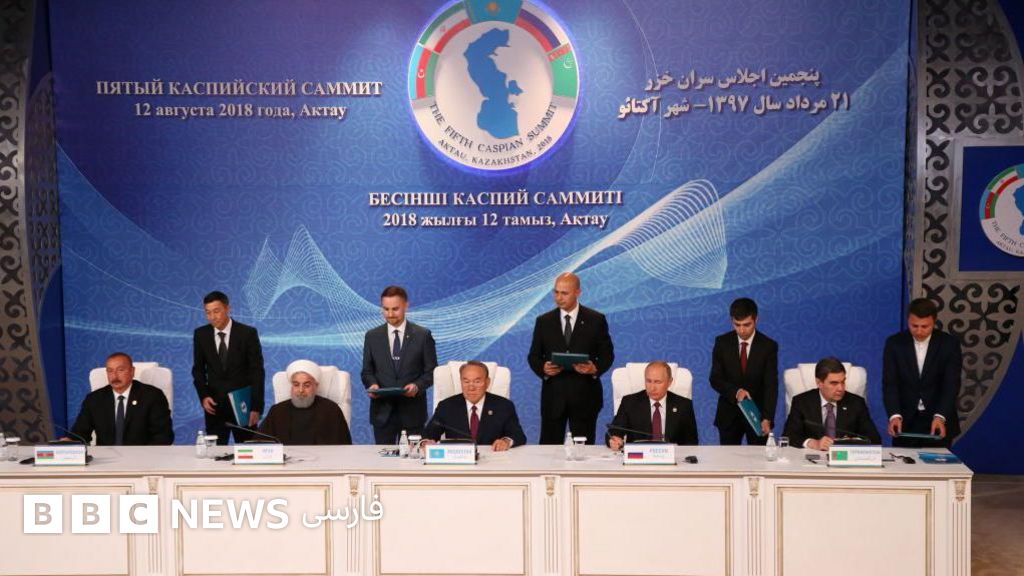
Covers the 2018 Caspian Sea Convention signed by the five littoral states in Aktau, which Iran has not ratified. Article 14 lets littoral states approve subsea pipelines themselves, clearing a legal path for the proposed Trans-Caspian gas line and reinforcing bypass corridors like the Middle Corridor and the Trump Route.
Five countries around the Caspian Sea signed a deal in 2018 about how to share the sea. It says neighbors can build gas pipes on the seabed without asking faraway countries like Iran. So now there are new roads and pipes for moving gas and goods from Central Asia to Europe that skip Iran entirely, and Iran worries it is being left out of big trade routes forever.
Analysis
Article 14 and the end of the veto
Article 14 of the 2018 Caspian Convention is the single provision that most directly threatens Iran's residual leverage over Caspian energy routing. It states that the route of a pipeline must be agreed with the states whose seabed the line crosses, provided Caspian environmental standards are met — and crucially, the article does not require the consent of any state whose waters the pipeline merely traverses. The practical reading, which the BBC's reporting underscores, is that a subsea line between Turkmenistan and Azerbaijan would not need Iranian or Russian approval, only Turkmen–Azerbaijani agreement plus environmental compliance. Iran's government under President Masoud Pezeshkian has now sent the ratification bill to parliament under a one-month urgency procedure, eight years after the text was signed, and the renewed debate has revived domestic concern that the document formally erodes Tehran's negotiating position on the seabed, the subsoil, and the disputed energy fields that bilateral Soviet-era arrangements once gave it.
The 300-kilometer Trans-Caspian route
The pipeline the convention most clearly enables is the long-debated Trans-Caspian project, a roughly 300-kilometer line running from the Turkmen coast near Turkmenbashi to the Sangachal terminal in Azerbaijan. From there, Turkmen gas could feed into the South Caucasus Pipeline, across Georgia and Turkey, and into the Southern Gas Corridor serving European buyers. The BBC notes the project is not the only option on the table — Turkmen gas has historically reached Western markets via Russia, via swap arrangements through Iran into Azerbaijan or Turkey, and via a 2025 bilateral Turkmen–Turkish gas deal routed through the Iranian network. What makes Trans-Caspian different is that it offers a single, continuous westward artery that is dependent on neither Moscow nor Tehran. The convention alone does not guarantee construction: financing, environmental assessments, the absorption capacity of the connected Azerbaijani and Turkish grids, and long-term commercial contracts remain the real obstacles. But by removing the legal need for Russian or Iranian sign-off, the convention removes a political veto that had stalled the project for two decades.
The TRIPP corridor and the squeeze on Iran
The bypass dynamic extends well beyond the Caspian seabed. The World Bank estimates that further investment in the Middle Corridor — the multimodal route carrying Chinese and Central Asian cargo through Kazakhstan, across the Caspian, and through Azerbaijan and Georgia to Turkey and Europe — could halve transit times and triple trade volumes by 2030. In August 2025, the leaders of Azerbaijan and Armenia initialled a peace text in Washington that includes unimpeded connectivity between mainland Azerbaijan and the Nakhchivan Autonomous Republic across Armenian territory, branded the Trump Route for International Peace and Prosperity (TRIPP), with a US–Armenia implementation framework signed in May 2026. Once operational, the corridor lets Azerbaijan reach Nakhchivan and Turkey without using Iranian roads, the same logic that shaped the Baku–Tbilisi–Ceyhan oil line from 2006 and Iraq's planned 1,200-kilometer Development Road from the port of Faw to Turkey. Energy analyst Omid Shokri, author of a book on US Caspian energy diplomacy, tells the BBC that once a country is excluded from a long-horizon corridor, the chance of re-entry narrows sharply; he argues that the Islamic Republic's policies, compounded by US sanctions, chronic underinvestment, and security frictions, have left roughly 90 million Iranians outside the benefits these projects are designed to capture. Geography has not changed, but the strategic value of that geography is being repriced in real time.
Key points
- The 2018 Caspian Convention was signed in Aktau, Kazakhstan, by Iran, Russia, Kazakhstan, Turkmenistan, and Azerbaijan; Iran remains the only signatory not to have ratified it.
- Article 14 allows littoral states to approve subsea pipelines crossing their own seabed, removing any requirement for Iranian or Russian consent on a Turkmenistan–Azerbaijan line.
- The proposed Trans-Caspian Pipeline would run roughly 300 km from Turkmenbashi to Azerbaijan's Sangachal terminal and onward to Europe via the Southern Gas Corridor.
- The World Bank says further investment in the Middle Corridor could halve transit times and triple trade volumes by 2030.
- The Trump-brokered TRIPP route through Armenia would connect mainland Azerbaijan to Nakhchivan and Turkey without using Iranian territory.
If Iran ratifies the convention and engages constructively, it could still negotiate favorable terms on seabed delimitation and potentially secure transit roles in complementary corridors rather than being structurally bypassed. Reviving swap arrangements, leveraging its existing pipeline network, and de-escalating regional tensions could partially restore its position as an east–west hub.
If the Middle Corridor, Trans-Caspian Pipeline, and TRIPP are completed on their current trajectories, Iran risks permanent structural exclusion from Eurasian energy and trade flows, deepening its economic isolation under sanctions. Once logistics networks, contracts, and infrastructure are built around an Iran-free route, the political cost of re-entry rises sharply, and the country's 90 million citizens would absorb the loss of transit revenue and foreign investment.