IRGC deputy chief: Iran defeated its enemy with spending minimal warfare amount
IRGC Deputy Commander-in-Chief Major General Mostafa Izadi claims Iran defeated its enemies in a 40-day US-Israel war while spending only one-hundredth of what the enemy spent. He praised journalists as commanders of the cognitive war.
Intelligence analysis by Llama
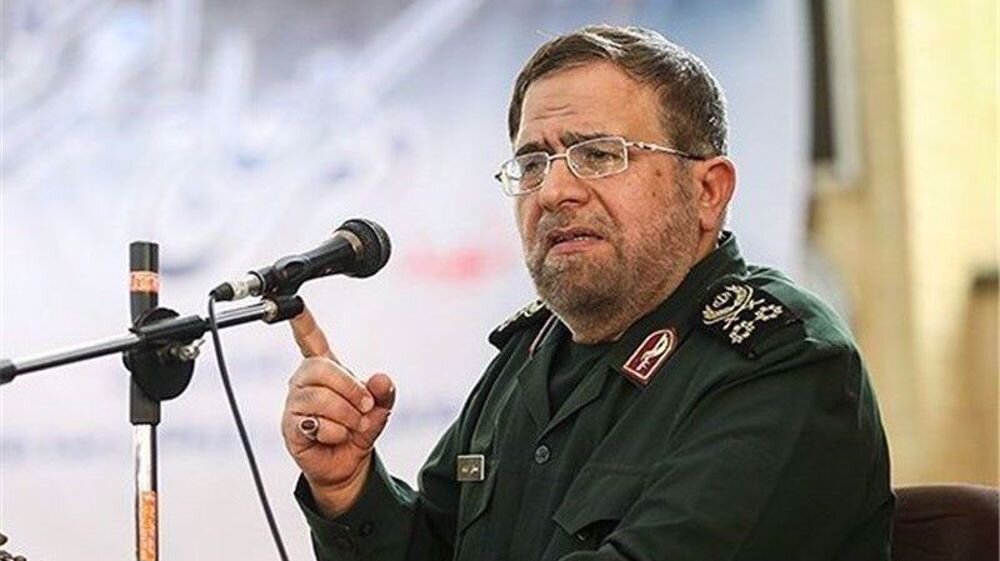
A senior IRGC commander tells journalists that Iran's Velayat-e Faqih system secured victory over a US-Israel coalition with minimal expenditure, bringing down more than 200 enemy aircraft across 100 counterattack waves. The remarks frame the conflict as a strategic and economic win for Tehran.
A top general in Iran's army said the country beat a much bigger enemy in a 40-day war, but only had to spend a tiny amount of money to do it. He also said Iran's soldiers shot down more than 200 enemy planes and fought back 100 times.
Analysis
One-hundredth of the enemy's expenditure
Major General Mostafa Izadi framed the financial dimension of the war as decisive, asserting that the Islamic Republic managed the conflict at one-hundredth of what the adversary spent. According to the IRGC deputy commander, this cost asymmetry demonstrates the efficiency of the Velayat-e Faqih system, which he credited with securing victory for "the fighters of Islam." The claim, made at a ceremony honoring journalists, doubles as a morale message: Tehran can absorb a combined US-Israeli assault without bankrupting itself, and the regime's command model outperforms the enemy's. For observers, the figure is unverifiable — Izadi offered no methodology or accounting — but its rhetorical purpose is clear. The statement ties wartime spending to ideological legitimacy, suggesting that the Islamic establishment's governance model is itself a weapon.
200 enemy aircraft brought down
Izadi highlighted the air defence performance of Iran's armed forces, stating that more than 200 enemy aircraft were shot down during the 40-day war. He paired this with praise for Hezbollah's resistance against six Israeli army divisions, describing the Lebanese movement's performance as "very important and valuable." The numbers are extraordinary and not independently corroborated in the article. They serve to communicate two ideas: that Iran's layered air defences functioned under sustained pressure, and that Iran's network of allies absorbed part of the military burden. For regional security analysts, the figure is a benchmark to watch — if Tehran's allies or adversaries can verify or contradict it, the credibility of the broader victory narrative shifts accordingly.
100 counterattack waves over 40 days
The article states that Iranian armed forces carried out 100 waves of counterattacks during the 40-day war that began February 28, targeting US and Israeli military assets and causing significant damage. The US-Israeli campaign, per the report, started with the assassination of Ayatollah Seyyed Ali Khamenei and several senior commanders. Izadi attributed the outcome to "strategic patience and stable governance," framing Iran's endurance — rather than any single battlefield result — as the decisive factor. The same article notes that Tehran is now fighting back in what it calls economic warfare and that adversaries are trying to isolate Iran through pressure and siege, claims Izadi rejected. The strategic message is continuity: the regime intends to convert its claimed military victory into political and economic resilience, and to depict any future sanctions as further proof of an enemy on the path to collapse.
Key points
- IRGC Deputy Commander-in-Chief Major General Mostafa Izadi said Iran fought the 40-day war at one-hundredth of the enemy's cost.
- He credited the Velayat-e Faqih system with securing victory and called journalists 'commanders of the cognitive war.'
- Izadi claimed Iranian forces brought down more than 200 enemy aircraft during the conflict.
- He praised Hezbollah for resisting six Israeli army divisions, calling it a 'very important and valuable' achievement.
- The article says the US-Israel campaign began February 28 with the killing of Ayatollah Khamenei and senior commanders, prompting 100 waves of Iranian counterattacks over 40 days.
If Izadi's framing is accurate, Iran has demonstrated that it can absorb a combined US-Israeli military campaign without strategic collapse, which could strengthen Tehran's negotiating position and deter future large-scale attacks. A perception of cost-effective resilience may also consolidate domestic support for the Islamic establishment.
The claims of minimal expenditure and decisive victory risk creating a triumphalist narrative that overstates Iran's actual position, potentially encouraging escalation rather than de-escalation. Continued economic siege, the unresolved leadership transition implied by the article's reference to Khamenei's assassination, and unverifiable battlefield statistics all leave room for strategic miscalculation.