China at UN: Countries must stop using sanctions and military coercion to seize other nations' resources
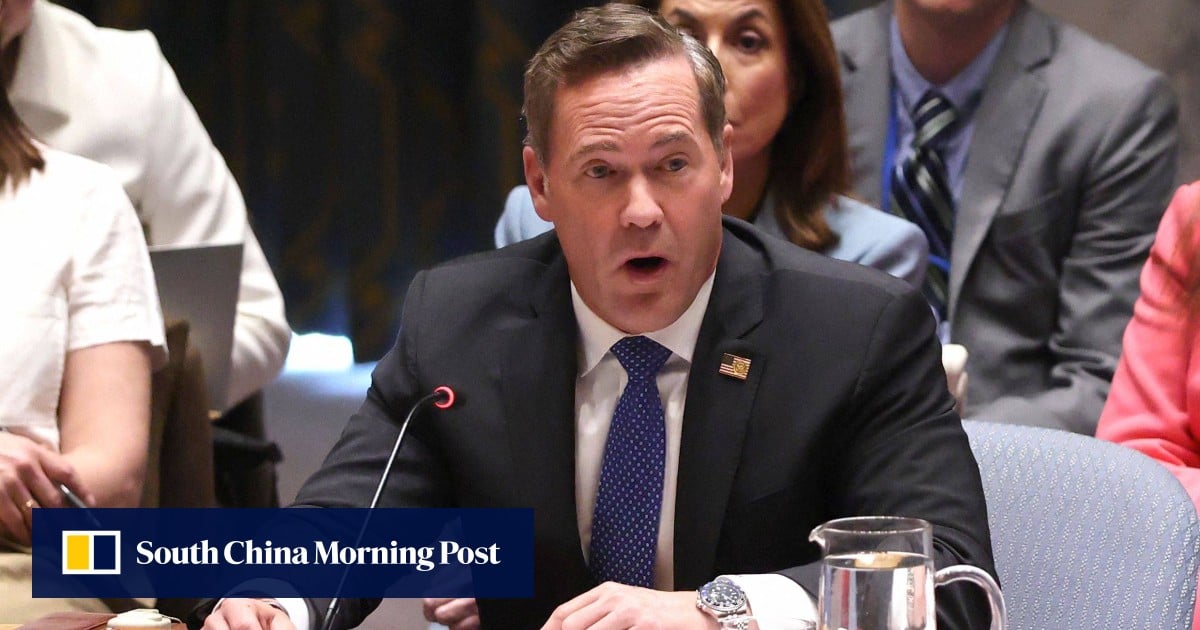
At a UN Security Council debate on natural resource governance, China's deputy UN envoy Sun Lei said international law grants countries absolute sovereignty over their resources and called on relevant states to stop using sanctions and military coercion to grab other coun…
Intelligence analysis by Llama

China's deputy UN representative used a Security Council debate on resource governance to denounce sanctions and military coercion as tools of resource extraction, positioning Beijing as a defender of state sovereignty and a cooperative partner for resource-rich developing nations.
At a big meeting at the United Nations, a Chinese leader said that some countries use punishments and soldiers to take valuable things like lithium and rare metals from other countries, and that has to stop. China wants to look like a helper for the countries that own those materials, so it can stay friends with them and keep selling and buying resources.
Analysis
Sovereignty as the red line
Sun Lei's core message at the July 22 UN Security Council debate was a direct attack on what China frames as the coercive use of economic and military power to extract resources from weaker states. By invoking the absolute sovereignty of countries over their own resources, the Chinese envoy is drawing a line that implicitly criticises US sanctions architecture, military interventions, and alliance-based supply-chain pressure. The language — that 'this principle cannot be challenged' and that 'colonial rule and plunder' must not be revived — places Beijing on familiar rhetorical ground, but the setting inside the UN Security Council rather than a bilateral press conference gives the complaint more diplomatic weight. It is also a preemptive counter to Western policy moves on critical minerals, which several capitals now treat as a national-security priority.
Critical minerals in the crosshairs
UN Secretary-General Guterres set the substantive frame, noting that control and exploitation of natural resources is reshaping the causes, dynamics and outcomes of conflict. Lithium, cobalt, nickel and rare earths were singled out for their growing strategic weight. Sun Lei picked up that thread, arguing that 'resource abundance does not naturally bring development and prosperity' and warning that 'camp confrontation' and 'exclusive small circles' built under the banners of 'de-risking' and 'national security' only 'disrupt market order and damage the common interests of all countries.' The reference is unmistakably aimed at US-led export controls, the G7 critical-minerals coordination, and supply-chain alliances designed to reduce Western dependence on Chinese-processed rare earths. By tying those initiatives to 'colonial plunder,' China reframes a structural economic competition as a moral violation.
Positioning as the partner of the resource-rich
The third pillar of Sun's remarks is China's self-presentation as a 'producer, consumer and trader' of natural resources and an 'advocate and promoter' of resource governance cooperation. He called on developed countries to honour aid commitments, transfer technology, build capacity and upgrade industries in resource-rich developing nations so that raw materials can be converted into higher value-added products, jobs and poverty reduction. The pitch is targeted squarely at the Global South — the same governments whose alignment China is actively courting in the critical-minerals arena. Whether the rhetoric translates into binding commitments at the UN or in bilateral deals with mineral-rich African and Latin American states will be the real test of whether this week's debate is a turning point or another cycle of competing narratives over who gets to set the rules for the energy-transition supply chain.
Key points
- China's deputy UN envoy Sun Lei told the Security Council that countries must stop using sanctions and military coercion to seize other states' resources, citing absolute sovereignty under international law.
- UN Secretary-General Guterres warned that control of lithium, cobalt, nickel and rare earths is reshaping conflict dynamics and fuelling geopolitical competition.
- Sun Lei criticised 'de-risking' and 'national security' justifications for building exclusive blocs, calling them a revival of 'colonial rule and plunder.'
- China positioned itself as a producer, consumer and trader of natural resources and an advocate for cooperation with resource-rich developing nations.
- Beijing urged developed countries to deliver on aid pledges, support technology transfer and help raise the value-added share of resource exports in producing states.
If Beijing follows through on its pledge to deepen cooperation with resource-rich developing states through technology transfer, capacity building and industrial upgrading, the UN framing could translate into new partnerships and a more stable, diversified critical-minerals supply chain that benefits producing nations.
Without concrete commitments, the statement risks hardening the standoff with Western governments already pursuing 'de-risking' and mineral-alliance policies, accelerating fragmentation of critical-minerals markets and prolonging the geopolitical competition that Guterres warned is fuelling conflict and humanitarian harm.