China's STEM students turn to Singapore as Western study options shrink
Chinese STEM students are increasingly choosing Singapore over Western universities as US-China tech rivalry and tighter immigration rules in Australia, Canada, the UK and the US restrict access. Singapore's long-running SM2 scholarship is the centrepiece of this talent p…
Intelligence analysis by Llama
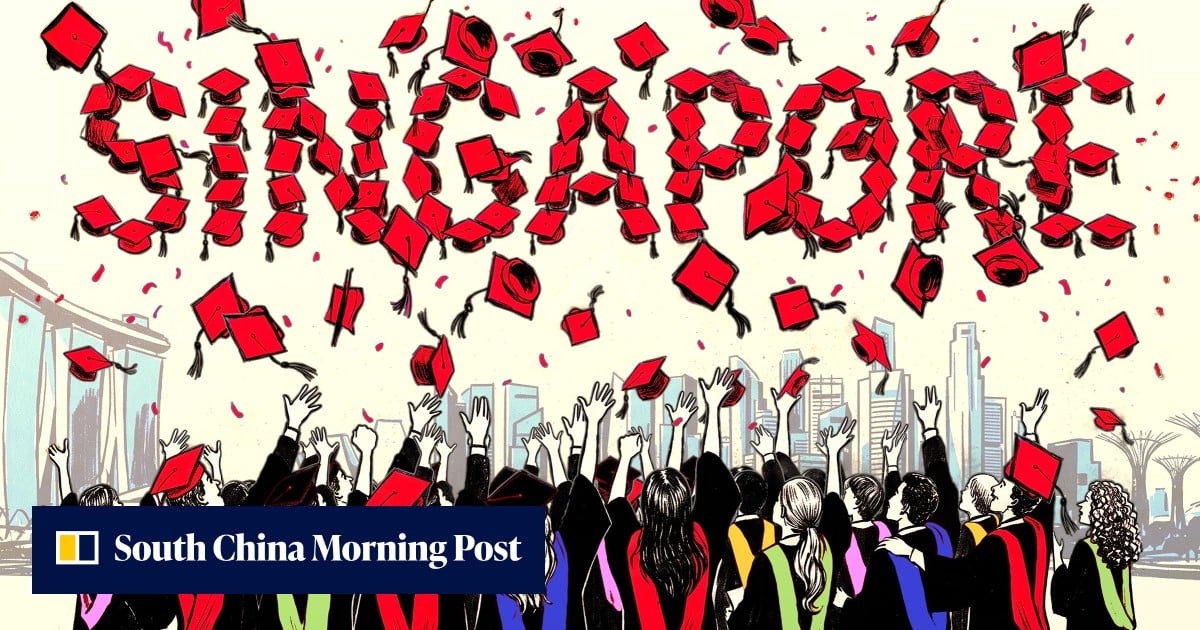
Escalating US-China tech competition and tightening immigration rules in the 'big four' Western study destinations are pushing China's top STEM students toward Singapore, where a state-backed scholarship programme offers fully funded degrees in exchange for a six-year work commitment.
Some of the smartest science kids from China used to fly to America or Europe for college, but now those countries are making it harder to get in. So more of them are going to nearby Singapore, where the government pays for their classes in exchange for staying to work there for six years after graduation. It's like when your favourite candy shop closes and you have to find a new one down the street.
Analysis
SM2 scholarship programme
The Senior Middle 2 (SM2) scholarship, launched in 1997 as a joint initiative between Singapore's and China's ministries of education, sits at the heart of the city state's effort to capture Chinese STEM talent. It recruits high-achieving second-year high school students and places them at the National University of Singapore or Nanyang Technological University for fully funded undergraduate degrees in science and engineering, plus living allowances. In return, graduates commit to working in Singapore for six years — a structure that, according to the article, effectively converts the scholarship into an early-stage talent pipeline feeding the city state's highly skilled workforce. A predecessor scheme, SM1, previously brought roughly 300 top mainland Chinese secondary students a year into Singapore's secondary and junior college system, evidence that the SM2 model is the latest evolution of a decades-old recruitment strategy rather than a sudden pivot.
The "big four" squeeze
The article frames the shift as a response to what it terms the "big four" study destinations — Australia, Canada, the United Kingdom and the United States — each tightening access through immigration controls, security protocols in laboratories, and the broader chill of US-China tech competition. That tightening, the report argues, has fractured a once-reliable Westbound trajectory for Chinese students seeking global academic prestige. Liu Jiaqi, writing for Singapore Management University, is quoted saying that Chinese students and their families are now asking "where an overseas education can still deliver academic prestige, employability and long-term security" — a question that, in the article's framing, increasingly points south rather than west. The result is a quiet but cumulative rerouting of one of the world's largest student migration flows.
Singapore's quiet advantage
Singapore's appeal rests on more than scholarships. Its universities consistently rank among Asia's strongest research institutions, the city state shares a time zone with China, and Mandarin is widely spoken — all of which lower the social cost of relocation for mainland families. The six-year work clause also functions as a soft form of talent retention: while Western universities graduate Chinese students who often return home or move to third countries, SM2 alumni are contractually tied to Singaporean employers for years after convocation. That makes the programme less a one-off education deal than a structured funnel of trained scientists and engineers into the city state's research labs, semiconductor plants and financial sector, with consequences for both Singapore's innovation capacity and the global balance of scientific talent.
Key points
- Chinese STEM students are increasingly choosing Singapore over Western universities as US-China tech competition and tighter immigration rules reshape student mobility.
- Singapore's SM2 scholarship, launched in 1997, offers fully funded science and engineering degrees at NUS and NTU in exchange for a six-year post-graduation work commitment.
- The article identifies Australia, Canada, the UK and the US as the 'big four' destinations whose access controls are driving the rerouting.
- A predecessor SM1 programme previously brought around 300 top mainland Chinese secondary students into Singapore each year.
- Liu Jiaqi of Singapore Management University says families are now weighing 'academic prestige, employability and long-term security' when picking study destinations.
Singapore's pipeline could deepen educational ties with China while giving students a world-class STEM education close to home, and the city state gains a steady flow of trained engineers and scientists to support its research and semiconductor sectors. If managed well, the arrangement may soften some of the friction of US-China decoupling by keeping cross-border academic exchange alive through a third hub.
The shift risks entrenching a fragmented global academic system in which Chinese students are funnelled into a narrower set of politically aligned destinations, limiting exposure to Western research networks that have historically driven frontier innovation. It could also leave Western universities with fewer top Chinese graduate students, weakening labs that depend on that talent, while binding graduates to Singapore in ways that constrain their long-term career choices.