US sends new aircraft carrier to Mideast amid concerns over USS Abraham Lincoln
The Pacific-based USS George Washington is heading toward the Middle East to relieve the USS Abraham Lincoln, which has been at sea for a record 240-plus days supporting the Iran war amid reported mental health and supply issues.
Intelligence analysis by Llama
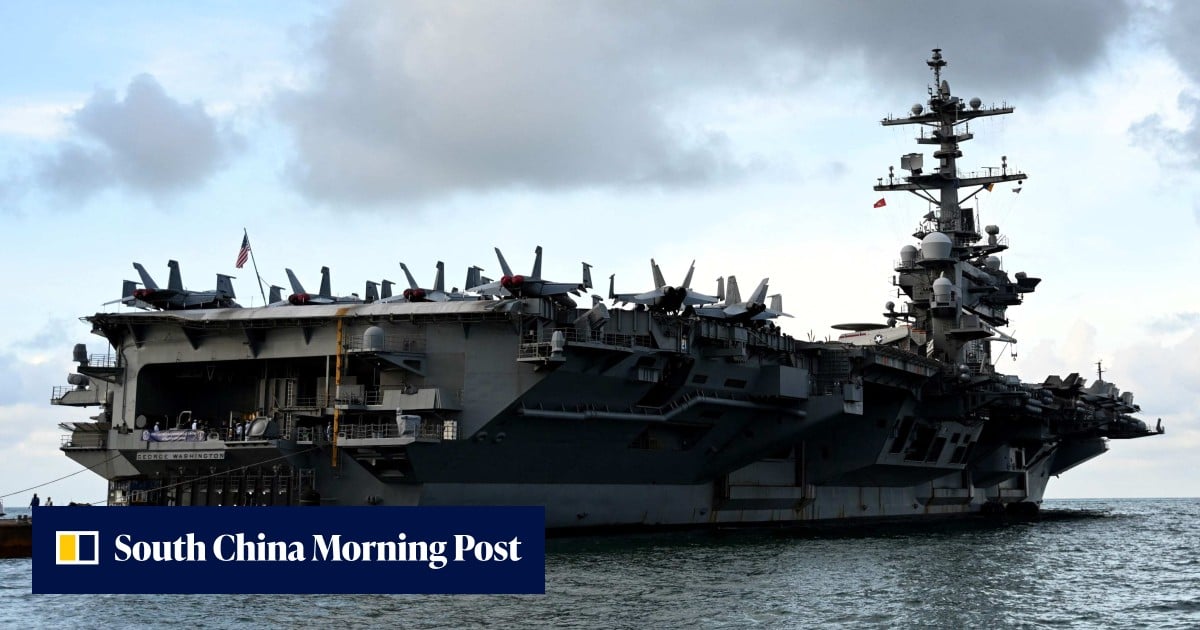
A second aircraft carrier is being repositioned from the Pacific toward the Middle East, reflecting both the strain on the USS Abraham Lincoln after a record 240-day deployment and the sustained US naval posture against Iran, including a blockade of the Strait of Hormuz.
Imagine a giant floating airport for fighter jets — that's an aircraft carrier. One of America's has been sailing non-stop for over eight months, which is very tiring for the crew, so another carrier is sailing from Vietnam toward the Middle East to take over. Two carriers are now there because the US is also blocking ships in a narrow waterway where lots of oil passes through.
Analysis
240-day deployment
The USS Abraham Lincoln has now spent more than 240 continuous days at sea, a figure described in the article as a record-setting stretch for a US carrier. That length of deployment explains why Washington is moving a replacement vessel at all. Long deployments of this kind typically produce cascading effects: maintenance backlogs, crew fatigue, and what the report describes as mental health and supply issues. The Navy is not publicly framing the rotation as an emergency, but the timing — pulling a Pacific-based hull forward rather than rotating in an Atlantic carrier — suggests operational pressure on the existing force structure in the Gulf.
Da Nang departure and the Strait of Malacca route
The USS George Washington's path is itself a story. It left port in Da Nang, Vietnam, last week and has since been tracked crossing the Singapore Strait, with a Navy official confirming it was in the Strait of Malacca heading toward the Indian Ocean. That route ties together two of the most strategically sensitive maritime corridors in Asia: the Singapore Strait, which funnels traffic between the South China Sea and the Indian Ocean, and the Malacca Strait, through which the bulk of East Asian energy imports flow. For a China-watching audience, the fact that the carrier was Pacific-based and is now transiting these chokepoints is a useful data point on how US task-group commitments are being shuffled, and on what the Pacific carrier force looks like in the interim.
Strait of Hormuz blockade and the two-carrier posture
The Lincoln is one of two carriers now stationed in the Middle East, operating alongside the blockade of Iranian ports in the Strait of Hormuz — a waterway the article flags as critical to global oil and natural gas trade. Maintaining two carriers in theater while running a blockade is an unusually heavy commitment, and it underlines how far the US-Iran confrontation has gone beyond episodic strikes into sustained campaign operations, referenced in the article as Operation Epic Fury. The dual-carrier presence also serves a deterrent function against any move to break the blockade, but it carries an opportunity cost: a Pacific carrier heading west means the Western Pacific is, for now, working with a thinner carrier roster than usual.
Key points
- Pacific-based USS George Washington left Da Nang, Vietnam, and is transiting the Singapore Strait and Strait of Malacca toward the Indian Ocean.
- The Wall Street Journal reported the Washington will replace the USS Abraham Lincoln, which has spent a record 240-plus continuous days at sea.
- The Lincoln has been supporting the US war on Iran, including Operation Epic Fury, alongside a blockade of Iranian ports in the Strait of Hormuz.
- Two US aircraft carriers are now stationed in the Middle East, an unusually heavy commitment tied to the blockade of a key global oil chokepoint.
- Reports of mental health and supply issues aboard the Lincoln have surfaced as the deployment has stretched well beyond normal carrier rotation cycles.
If the rotation proceeds smoothly, the Lincoln can return to port for crew rest, maintenance, and resupply while the George Washington takes over the deterrence mission, allowing the US to sustain its blockade posture in the Strait of Hormuz without a gap in coverage. A planned handover would also reduce the risk of an accident at sea that comes with extended deployments under strain.
If the Lincoln cannot be safely relieved on schedule, the US could be forced to either thin its Middle East carrier presence or continue stretching an exhausted crew, raising the risk of operational mistakes. A Pacific carrier leaving for the Indian Ocean also leaves the Western Pacific carrier roster temporarily lighter, a window regional adversaries may seek to test.
Market signals
- OIL The article highlights a US Navy blockade of Iranian ports in the Strait of Hormuz, a critical oil chokepoint, supporting a risk premium on crude.
AI-generated analysis of potential market relevance. Not financial advice.