Chinese coastguard has 0.3% chance of using weapons in disputed waters, war game suggests
A war game simulation suggests the Chinese coastguard would use weapons in disputed waters only 0.3% of the time under current rules. Researchers developed an AI to better assess vessel intentions and reduce this risk.
Intelligence analysis by Gemini 2.5 Flash Lite
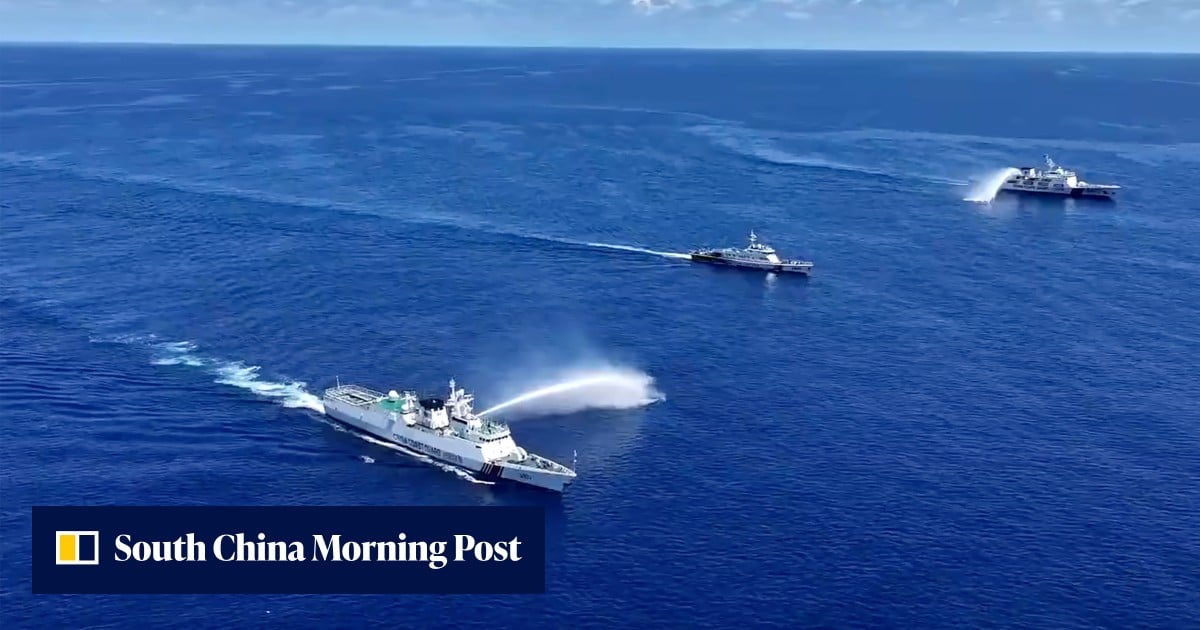
Chinese researchers have developed an AI framework to help coastguard vessels navigate tense maritime encounters in disputed waters. A war game simulation indicated a low probability (0.3%) of weapon use under existing protocols, but Beijing seeks to eliminate this risk entirely. The AI continuously assesses vessel intentions, moving beyond simple 'hostile' or 'harmless' classificatio…
Imagine a game where you have to decide if someone is being friendly or trying to trick you. Chinese coastguard ships sometimes meet unknown boats in the sea. A computer game showed they rarely use weapons, but China wants to be even safer. So, they made a smart computer program, like a super-detective, that watches the boats and figures out what they might do, helping the coastguard decide the best, safest move.
Analysis
Chinese Coastguard Encounters
The South China Morning Post article details a fascinating war game simulation conducted by Chinese researchers focused on the operational challenges faced by the Chinese coastguard in disputed maritime territories. The simulation revealed that under the current rule-based command system, the likelihood of the coastguard resorting to lethal force is remarkably low, estimated at just 0.3% of the time. This statistic, while seemingly small, is still considered too high for Beijing, especially given the sensitive nature of these contested waters. The scenarios explored involved complex interactions where unidentified vessels circled and probed a coastguard ship, raising questions about their true intentions – whether they were benign fishermen or engaged in coordinated harassment tactics. The core problem highlighted is the difficulty of making split-second decisions in high-stakes maritime stand-offs, where misjudgment can lead to dangerous escalation.
AI Framework Development
To address the perceived risk, even at 0.3%, the research team has developed an advanced artificial intelligence (AI) framework. This AI is designed to function like a seasoned mariner, capable of 'reading' a vessel's intentions by continuously calculating the probabilities of various possible actions. Instead of a binary classification of 'hostile' or 'harmless,' the AI evaluates a spectrum of intentions, ranging from routine fishing activities to more aggressive probing or harassment. This nuanced approach allows for a more adaptive and precise response from the coastguard. The goal is to push the probability of weapon use down to zero, thereby enhancing safety and de-escalating potential conflicts before they begin. The AI's continuous assessment and adjustment of response strategies are key to achieving this objective.
Maritime Risk Reduction
The implications of this AI framework extend beyond mere risk reduction in specific encounters. For China, which has been increasingly active in asserting its territorial claims in areas like the South China Sea and East China Sea, such technology could be instrumental in managing its maritime presence. By providing coastguard commanders with more sophisticated decision-support tools, the AI aims to prevent accidental escalations that could have significant diplomatic and geopolitical repercussions. The ability to accurately discern intent in real-time, without relying solely on pre-defined rules that might not cover every eventuality, is a significant step. This research underscores a broader trend in military and security applications where AI is being employed to enhance situational awareness and decision-making in complex, dynamic environments, particularly in contested maritime zones.
Key points
- A war game simulation indicates the Chinese coastguard uses weapons in disputed waters only 0.3% of the time.
- Researchers developed an AI framework to better assess vessel intentions and reduce this risk to zero.
- The AI continuously calculates the odds of multiple possible intentions, not just 'hostile' or 'harmless'.
- This technology aims to prevent accidental escalations in sensitive, disputed maritime areas.
- Beijing considers even a 0.3% chance of weapon use in disputed waters to be too high.
The development of this AI framework could lead to a significant reduction in maritime incidents and accidental escalations in disputed waters. By providing more accurate real-time assessments of vessel intentions, it could enable de-escalation strategies, fostering greater stability in tense regions. This technology might also serve as a model for other nations seeking to manage maritime traffic and potential conflicts more safely.
Over-reliance on AI could lead to unforeseen errors or misinterpretations, potentially causing unintended escalations if the system fails to accurately gauge intentions. The continuous nature of the AI's assessment might also create a dynamic where responses become overly reactive, rather than proactive, in complex, multi-vessel scenarios. Furthermore, the development and deployment of such AI could be perceived as an escalatory step by other nations, leading to an arms race in maritime AI capabilities.