Chinese humanoid robot beats Usain Bolt's sprint world record
A humanoid robot from Beijing-based X-Humanoid reportedly broke Usain Bolt's 100-meter sprint world record, completing 109 yards in 9.39 seconds at the World Humanoid Robot Games in Beijing. Another robot from the same company also surpassed the human record in the standi…
Intelligence analysis by Gemini 2.5 Flash
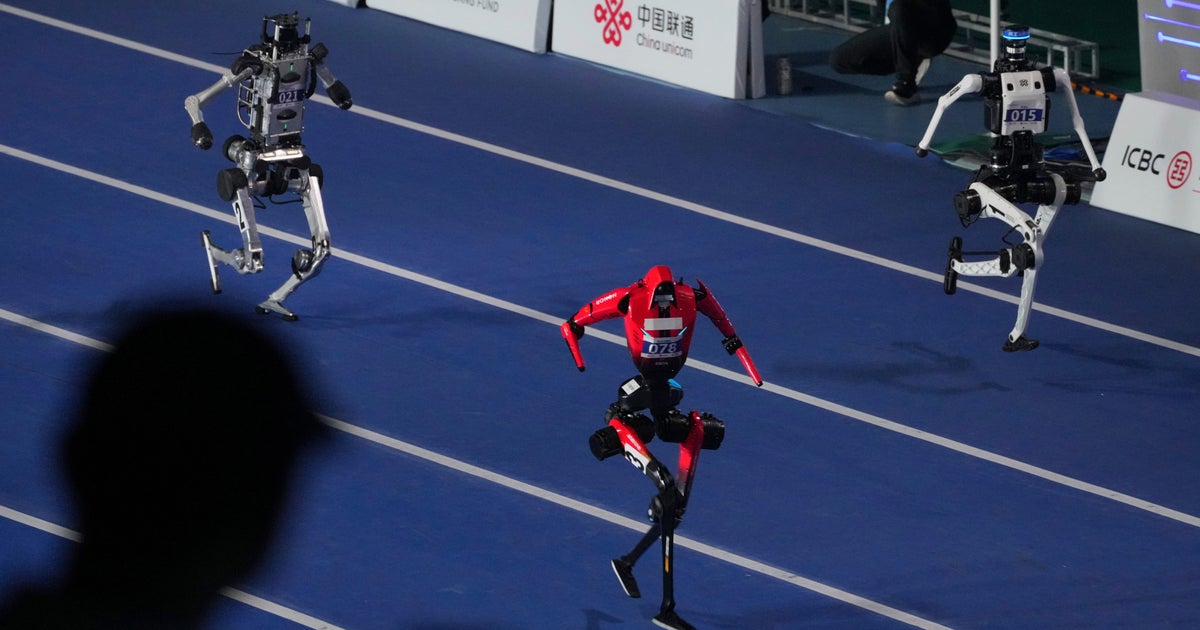
At the World Humanoid Robot Games in Beijing, a Chinese humanoid robot achieved a 9.39-second 100-meter sprint, beating Usain Bolt's 9.58-second record. This event, featuring over 2,000 robots, showcases China's rapid advancements in robotics, occurring amidst recent U.S. actions like the FCC ban on foreign-made humanoid robot imports due to national security concerns.
Imagine a super-fast robot from China that can run 100 meters quicker than the fastest human ever, Usain Bolt! It ran so fast, it had to crash into a big pillow to stop. Another robot also jumped higher than any person. This shows how good China is getting at making robots, but some grown-ups in America are worried because they think these robots could be used for other things, so they've stopped some from coming into the country.
Analysis
The recent World Humanoid Robot Games in Beijing served as a prominent platform for China to exhibit its rapid advancements in robotics, particularly in the realm of humanoid machines. The event, now in its second year, brought together over 2,000 humanoid robots to compete in various sports, aiming to demonstrate the practical capabilities and potential of these sophisticated machines. The organizers and participating robot makers highlighted these achievements as a testament to China's growing prowess in a critical technological domain.
X-Humanoid
Beijing-based X-Humanoid emerged as a key player at the World Humanoid Robot Games, with its creations achieving two significant milestones. One of their humanoid robots reportedly completed a 100-meter sprint in an astonishing 9.39 seconds, a time that surpasses Usain Bolt's 2009 world record of 9.58 seconds. This achievement, if validated under comparable conditions, represents a substantial leap in robotic locomotion and agility. Furthermore, another robot from X-Humanoid demonstrated exceptional vertical capability by achieving a standing high jump of 2.88 meters, exceeding Cuba's Javier Sotomayor's 1993 human record of 2.45 meters. These performances, while impressive, were not without incident, as some robots experienced malfunctions, including tripping, falling, and even catching fire during the competitions.
9.39 seconds
The reported 9.39-second 100-meter sprint by a Chinese humanoid robot is a symbolic achievement, pushing the boundaries of what is mechanically possible for bipedal machines. While the context of these 'robot games' differs significantly from human athletic competitions, the raw speed demonstrated by the robot highlights advanced engineering in motor control, balance, and power delivery. The robots' method of stopping, by slamming into a cushion and falling, indicates that controlled deceleration at such speeds remains a challenge, suggesting areas for further development in safety and operational finesse. This record, alongside the high jump feat, positions China as a frontrunner in developing highly capable humanoid robotics, even if the technology is currently more suited for demonstrations than widespread practical application.
Unitree
The advancements showcased by Chinese robot makers like X-Humanoid occur against a backdrop of increasing geopolitical tension, particularly with the United States. The U.S. Federal Communications Commission (FCC) recently announced a ban on imports of new foreign-made humanoid robots, explicitly citing national security reasons and targeting China. This move reflects growing concerns within the U.S. government regarding the potential dual-use nature of advanced robotics and the implications for data security and strategic advantage. Adding to this, the Pentagon recently included Unitree, another leading Chinese humanoid robot manufacturer, on a list of companies deemed to have ties with the Chinese military. Beijing has vehemently denied these accusations, but the U.S. actions underscore a broader strategy to limit China's access to and deployment of advanced technologies, framing the robotics race as a matter of national security.
Key points
- A Chinese humanoid robot from X-Humanoid reportedly broke Usain Bolt's 100-meter sprint record with a time of 9.39 seconds.
- Another robot from the same company surpassed the human standing high jump record, reaching 2.88 meters.
- The achievements occurred at the World Humanoid Robot Games in Beijing, an event showcasing China's robotics progress.
- The U.S. FCC recently banned imports of new foreign-made humanoid robots, citing national security concerns and targeting China.
- The Pentagon added Chinese robot maker Unitree to a list of companies with alleged ties to the Chinese military, which Beijing denies.
The rapid advancements in humanoid robotics, as demonstrated by these record-breaking performances, could lead to significant breakthroughs in automation, potentially enhancing efficiency in various industries and performing tasks too dangerous or difficult for humans. Continued innovation could accelerate the development of more versatile and intelligent robots for beneficial societal applications.
The geopolitical tensions surrounding advanced robotics, highlighted by the U.S. import ban and national security concerns, could lead to a fragmented global technology landscape, hindering international collaboration and slowing overall progress. There's also a risk that these powerful technologies could be misused or contribute to an arms race in autonomous systems.