Chinese robots tackle tennis, smash track records at World Humanoid Robot Games
Chinese humanoid robots competed in various sports, including a challenging tennis match, at the second World Humanoid Robot Games in Beijing, showcasing both advancements and persistent limitations.
Intelligence analysis by Gemini 2.5 Flash
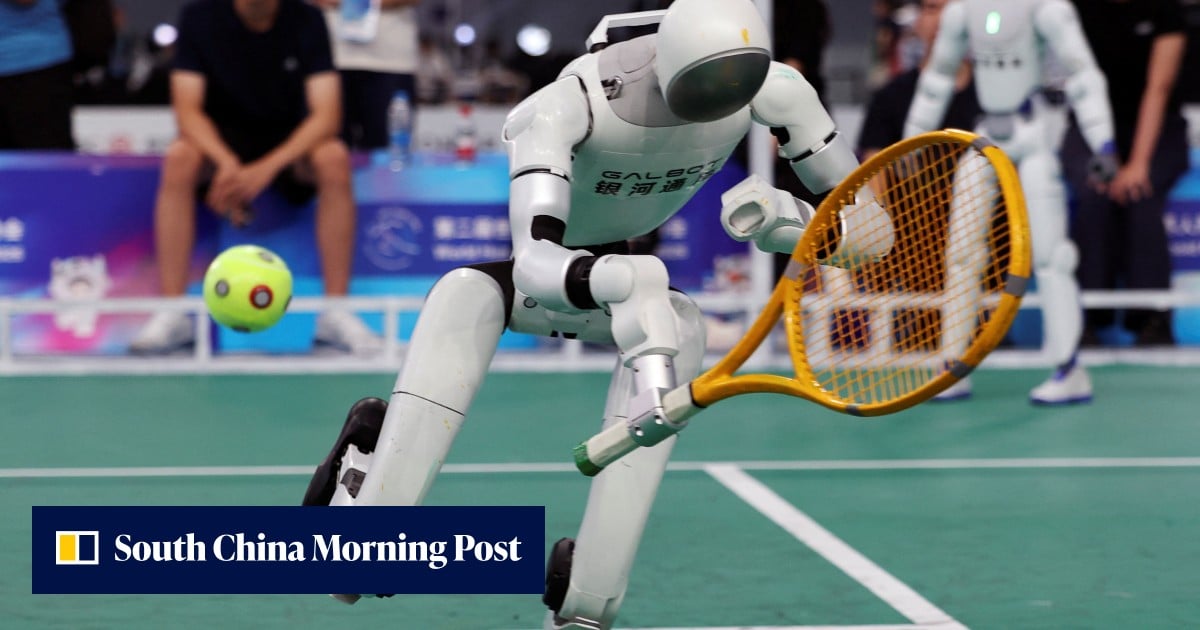
The World Humanoid Robot Games in Beijing featured over 2,000 robots from 600 teams competing in 51 events, including new additions like table tennis and kickboxing. A highlight was a tennis demonstration by a Galbot-developed robot, which managed to return shots but also experienced a fall, underscoring current challenges in robot balance, autonomy, and battery life.
Imagine a big sports day, but instead of people, it's robots playing games like running, football, and even tennis! One robot tried to play tennis, hitting the ball back and forth, which is super tricky because it has to move fast and guess where the ball will go. Sometimes it did great, but it also fell over, showing that even smart robots still need to learn how to keep their balance and move perfectly, just like a little kid learning to ride a bike.
Analysis
The second World Humanoid Robot Games serves as a significant platform for evaluating the global progress in humanoid robotics, particularly from Chinese developers. The sheer scale of the event, featuring 2,056 robots from over 600 teams competing in 51 events, demonstrates a robust and competitive research and development ecosystem. New competitions like table tennis and kickboxing, alongside expanded scenario-based tasks in industrial, hotel, home, and logistics settings, indicate a push towards more complex and practical applications beyond basic locomotion.
World Humanoid Robot Games
The World Humanoid Robot Games, now in its second iteration, has significantly expanded its scope and participation, reflecting a growing global interest and investment in humanoid robotics. The event's diverse range of competitions, from running and football to more intricate tasks like table tennis and combat, provides a comprehensive assessment of robot capabilities across various domains. This broad spectrum of challenges helps identify specific areas where current robotic technology excels and where further innovation is critically needed, pushing the boundaries of what humanoid robots can achieve in dynamic, real-world environments.
The inclusion of scenario-based events is particularly noteworthy, as it shifts the focus from isolated athletic feats to integrated tasks relevant to industrial production, hospitality, domestic assistance, and logistics. This practical orientation suggests a strategic effort to bridge the gap between laboratory research and commercial deployment. By simulating real-world operational demands, the games encourage the development of robots that are not only agile and coordinated but also capable of performing useful functions in complex, unstructured settings, thereby accelerating their integration into various sectors of the economy.
Galbot
The Beijing-based company Galbot showcased a humanoid robot capable of playing tennis, a task that demands exceptional real-time processing, predictive analytics, and fine motor control. The robot's ability to track a fast-moving ball, predict its trajectory, reposition itself, and execute forehand and backhand shots represents a considerable engineering achievement. This demonstration highlights advancements in sensor integration, motion planning algorithms, and robotic dexterity, pushing the envelope for autonomous interaction in highly dynamic environments.
Despite its impressive performance, the Galbot robot's momentary loss of balance and subsequent fall during the tennis match underscored critical limitations that still plague humanoid robotics. Issues such as maintaining stability during rapid movements, achieving true autonomy without human intervention, and overcoming battery constraints remain significant hurdles. These challenges are not unique to Galbot but are common across the field, indicating that while robots can perform complex actions, robust and reliable operation in unpredictable scenarios still requires substantial development.
2022 Winter Olympics
The choice of Beijing’s National Speed Skating Oval, a venue from the 2022 Winter Olympics, for the World Humanoid Robot Games lends a sense of grandeur and international significance to the event. Utilizing such a prominent facility elevates the profile of humanoid robotics, positioning it as a field of global competition and innovation akin to major human sporting events. This strategic venue selection helps to draw public attention and foster greater interest in the technological advancements being made in this sector.
Hosting the games in a high-profile venue also symbolizes China's ambition and investment in becoming a leader in advanced robotics. By providing a grand stage for these competitions, the event not only showcases current capabilities but also inspires future generations of engineers and researchers. The setting reinforces the idea that robotics is a frontier of human endeavor, with the potential to revolutionize various aspects of society, from industry to daily life, much like the athletic achievements celebrated at the Olympic Games.
Key points
- The second World Humanoid Robot Games in Beijing featured 2,056 robots from over 600 teams competing in 51 events.
- New competitions included table tennis and kickboxing, alongside expanded scenario-based tasks in industrial, hotel, home, and logistics settings.
- A robot developed by Beijing-based Galbot demonstrated playing tennis, successfully trading forehands and backhands with human players.
- The tennis demonstration also highlighted current limitations, as the robot lost balance and fell while chasing a ball.
- Key weaknesses identified include balance issues, limited autonomy, battery constraints, and the need for faster networks.
The advancements demonstrated at the games, particularly in complex tasks like tennis, suggest a future where robots can perform highly intricate physical activities with increasing precision and autonomy. Overcoming current limitations in balance, battery life, and network speed could lead to more versatile and reliable humanoid robots capable of assisting in diverse real-world applications, from industrial settings to personal care.
Despite the impressive displays, the robots' persistent weaknesses, such as balance issues and limited autonomy, indicate that truly robust and independent humanoid robots are still a distant prospect. These fundamental challenges, coupled with battery constraints and the need for faster networks, highlight significant engineering hurdles that could slow down the practical deployment and widespread adoption of these advanced machines.