Corals in East Asian Seas holding out as world’s coral reefs shrink due to more frequent marine heatwaves
East Asian Seas corals stable despite global decline, report finds. Macroalgae not increasing in region.
Intelligence analysis by Qwen 2.5 (3B)
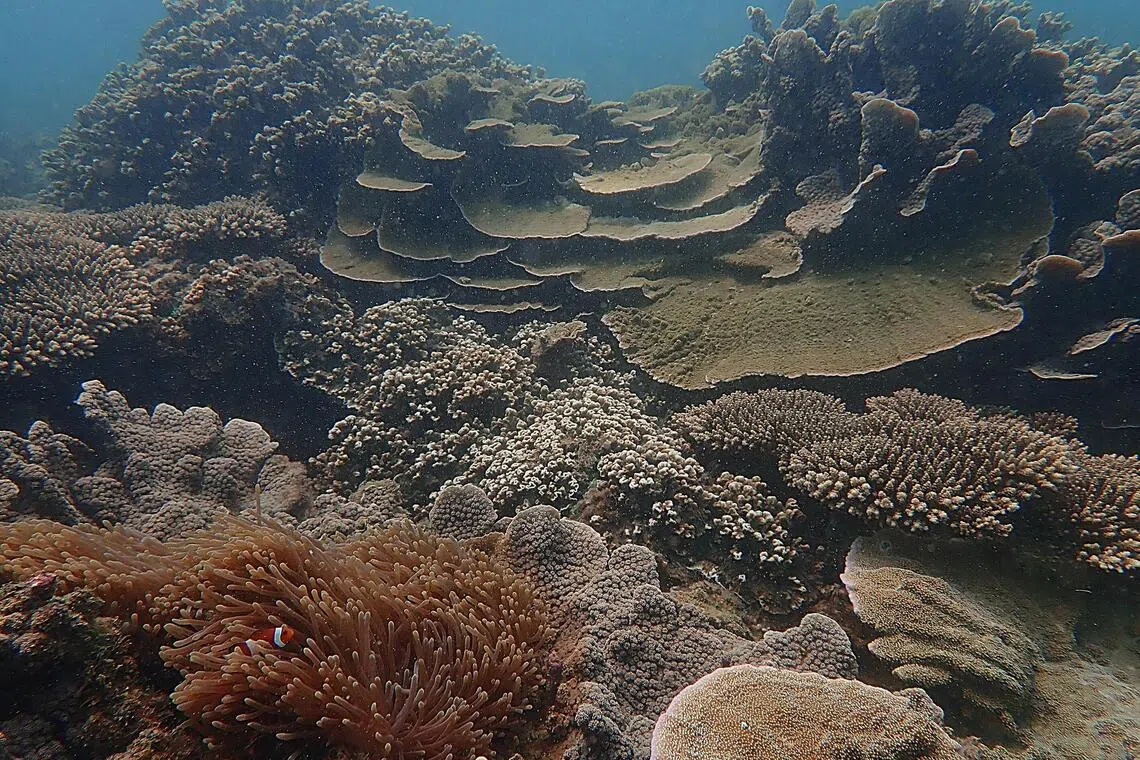
Coral reefs in East Asian Seas, including Singapore, have remained stable over four decades despite global declines caused by frequent marine heatwaves and bleaching events.
Coral reefs in East Asian Seas, including Singapore, have remained stable over four decades despite global declines caused by frequent marine heatwaves and bleaching events. This is because the corals have heat-tolerant traits and microorganisms that help them survive warmer temperatures.
Analysis
{"
Marine Heatwaves and Bleaching Events":"Global coral reefs have been experiencing frequent marine heatwaves and bleaching events, leading to a decline in coral cover. In contrast, the East Asian Seas region, including Singapore, has shown remarkable stability in coral cover over the past four decades. This stability is attributed to the presence of heat-tolerant traits and microorganisms in the corals, as well as regional stability masking local variations.","
Traits of Heat-Tolerant Corals":"Corals in the East Asian Seas, such as those in Singapore, have developed heat-tolerant genetic traits and microorganisms that confer them greater heat resilience. These traits allow the corals to produce offspring that are naturally resilient to warmer sea surface temperatures, which could confer greater resilience against heat waves.","
Regional Stability and Local Variations":"While the East Asian Seas region has shown remarkable stability in coral cover, local variations still require detailed monitoring. The presence of macroalgae, which can hinder reef recovery, is not increasing in the region, indicating a positive trend. However, the region still faces threats from pollution, overfishing, and coastal development.","
Future Outlook":"The report suggests that the East Asian Seas region could serve as a model for coral reef conservation. However, the region still faces threats from climate change and other factors. The report also highlights the importance of continued monitoring and research to understand the resilience of coral reefs in the region."}
Key points
- Coral reefs in East Asian Seas, including Singapore, have remained stable over four decades despite global declines caused by frequent marine heatwaves and bleaching events.
- The presence of heat-tolerant traits and microorganisms in the corals allows them to survive warmer temperatures.
- The region still faces threats from pollution, overfishing, and coastal development, despite the stability of coral reefs.
- The stability of coral reefs in the East Asian Seas region could serve as a model for coral reef conservation.
- Continued monitoring and research are needed to understand the resilience of coral reefs in the region.
The stability of coral reefs in the East Asian Seas region could serve as a model for coral reef conservation, providing insights into how to protect and restore coral reefs globally.
Despite the stability of coral reefs in the East Asian Seas region, the region still faces threats from climate change and other factors, highlighting the need for continued monitoring and research.