David Hockney Slowed Down Time
An appreciation of David Hockney argues that his art made viewers look longer, think slower, and see technology and modern life differently.
Intelligence analysis by GPT-5.4 Mini
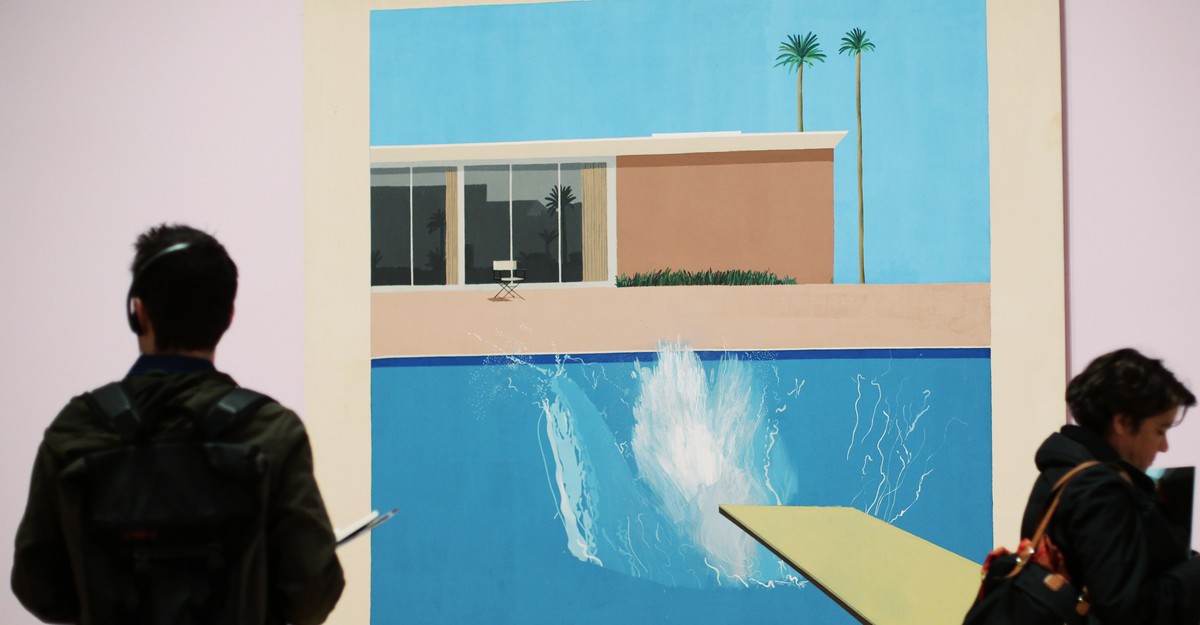
The Atlantic frames Hockney as an artist obsessed with how images are made and how long they take to see. From A Bigger Splash to iPad drawings, his work is presented as a reply to a screen-saturated culture that rushes past attention.
David Hockney made pictures that asked people to stop and stare, like pausing a video to notice tiny details. The article says his art was like a timer in reverse: instead of stealing time, it gave some back.
Analysis
Hockney as a slow-looking artist
The article treats David Hockney’s work as a challenge to the speed of modern image culture. In A Bigger Splash, he spent two weeks refining the splash itself, turning a split-second event into something that demands patient looking. The point is not just realism; it is duration. Hockney believed paintings and drawings contain depth that photography alone can miss.
Technology, but on his terms
Rather than reject new tools, Hockney kept experimenting with them. The piece notes his Polaroid collages, faxed drawings, copier experiments, and later iPad art. That curiosity matters because it shows he was not anti-technology. He was interested in any device that changed how pictures were made, while still insisting that drawing and painting could recover what fast media lose.
California, perspective, and time
The article also places Hockney in a specifically American visual landscape: sun-soaked Los Angeles, suburban edges, pools, sprinklers, and ordinary backyard moments. His multipoint and aerial perspectives are described as almost game-like, echoing modern digital graphics before screens became unavoidable. The writer suggests that Hockney could turn everyday scenes into images that feel both immediate and strangely outside time.
The larger argument
The essay’s broader claim is that Hockney slowed down vision. In a world where images can consume attention instantly, his art gives time back to the viewer. Even the newer iPad works are presented as part of that same project: not busy distraction, but a continuation of his lifelong interest in how looking works.
Key points
- The article presents Hockney as an artist who made viewers slow down and pay attention.
- It argues that his paintings and drawings have a depth that photography alone lacks.
- Hockney is shown as deeply interested in image-making technology, from Polaroids and fax machines to iPads.
- The essay ties his legacy to California scenes and to the visual language of modern American life.
- His work is framed as a response to a screen-heavy culture that often rushes past meaning.
If Hockney’s approach keeps resonating, more artists and viewers may value careful looking over quick scrolling. His mix of old tools and new devices could also encourage people to use technology more thoughtfully in art.
The piece suggests a real risk that fast digital images keep training people to look briefly and move on. If that trend deepens, the kind of slow attention Hockney celebrated may become rarer, even as his work stands as a reminder of what is being lost.