Did an explosion occur in Delhi during the 2026 BRICS Summit? | Fact Check
A viral video falsely claimed an explosion near Delhi's Red Fort Metro Station during the 2026 BRICS Summit, killing eight people. A fact-check revealed the footage was from a 2025 car blast, maliciously edited to mislead the public.
Intelligence analysis by Gemini 2.5 Flash
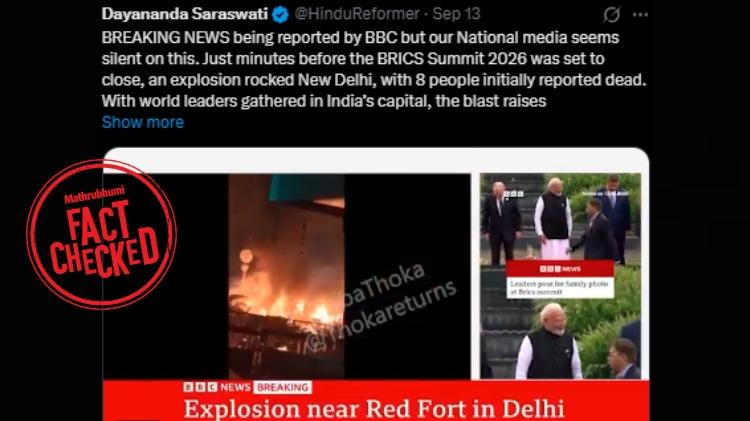
A video circulating on social media purported to show an explosion near the Red Fort Metro Station in Delhi during the 2026 BRICS Summit, raising concerns about security. However, investigations confirmed that the visuals were old, depicting a suicide car bombing from November 2025, and were deceptively combined with BRICS Summit narratives to spread misinformation.
Imagine someone shows you a video of a big fire and says it happened at your school today, making everyone worried. But actually, that video was from a fire at a different school last year! That's what happened here: a video of an old car explosion in Delhi was shared, pretending it was a new blast during a big meeting of world leaders, trying to trick people into thinking something bad happened when it didn't.
Analysis
2026 BRICS Summit
The viral video falsely claiming an explosion during the 2026 BRICS Summit in Delhi highlights a concerning trend in digital misinformation. By juxtaposing unrelated footage with a high-profile international event, the creators aimed to lend credibility to a fabricated narrative. This tactic exploits public interest in significant diplomatic gatherings, making the false claim appear more urgent and believable.
The timing of such misinformation, coinciding with a major summit, is particularly insidious. It seeks to sow doubt about the host nation's security capabilities and potentially disrupt the diplomatic atmosphere. The claim that "national media is silent" further attempts to undermine trust in established news outlets, pushing audiences towards unverified sources.
Red Fort Metro Station
The choice of the Red Fort Metro Station as the alleged site of the explosion is strategic, leveraging a recognizable landmark in Delhi. This specific location adds a layer of perceived authenticity to the fabricated event, making it more impactful for local audiences. The historical significance of the Red Fort also amplifies the emotional resonance of such a false claim.
The fact-check meticulously traced the visuals used in the viral video back to a genuine incident: the November 2025 car blast near the Red Fort. This demonstrates how old, real footage can be repurposed and recontextualized to create entirely new, false narratives. The deliberate editing of past events with current contexts is a common technique used by purveyors of misinformation to deceive viewers.
Dr. Umar Un Nabi
The original 2025 Red Fort explosion, which the viral video's footage depicts, was a significant security incident involving a suicide bombing. The National Investigation Agency (NIA) identified Dr. Umar Un Nabi, an assistant professor at Al Falah University, as the perpetrator, linking the attack to Al-Qaeda. This detail underscores the gravity of the actual event from which the visuals were taken.
The malicious editing of these serious historical visuals into a fabricated 2026 BRICS Summit explosion narrative is a clear attempt to exploit public memory and fear. It not only disrespects the victims of the original incident but also creates unnecessary alarm regarding current events. Such acts of digital manipulation pose a serious challenge to public safety and information integrity.
Key points
- A video falsely claimed an explosion occurred near Delhi's Red Fort Metro Station during the 2026 BRICS Summit.
- The viral video alleged eight deaths and questioned the security of the diplomatic gathering.
- A reverse image search revealed the footage was from a November 2025 car blast near Red Fort.
- The 2025 incident was a suicide bombing by Dr. Umar Un Nabi, linked to Al-Qaeda, as investigated by the NIA.
- The video was created by maliciously editing old visuals with current BRICS Summit narratives to mislead the public.
Effective fact-checking efforts, like the one presented, can swiftly debunk false narratives, preventing widespread panic and maintaining public trust in official information channels. This proactive approach helps to educate the public on media literacy and the dangers of misinformation.
Despite debunking, such viral videos can still spread rapidly across social media platforms, potentially reaching a large audience before corrections are widely seen. This can erode public confidence in security measures and legitimate news sources, fostering an environment of distrust and confusion.