English language proficiancy training for teachers begins
A month-long English Language Proficiency Training Program for public sector teachers has commenced in Rawalpindi, Pakistan, aiming to enhance their communication skills and improve educational outcomes. This second batch initiative is a collaboration between PECTAA, Berl…
Intelligence analysis by Gemini 2.5 Flash
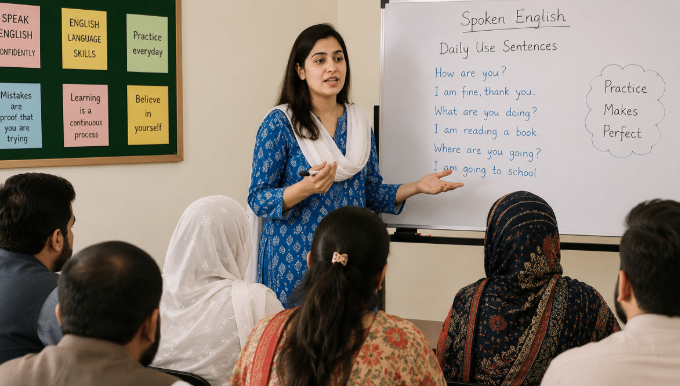
The District Education Authority Rawalpindi, in partnership with PECTAA and Berlitz, has launched the second phase of a month-long English language proficiency training for government school teachers. The program seeks to empower educators with modern communication skills, directly impacting classroom delivery and academic excellence across the district's public institutions.
Imagine your school teachers are learning to speak English even better, like superheroes learning new powers! This special training in a city called Rawalpindi helps them talk more clearly and teach exciting new things in English. It's like giving them a super-boost so they can make learning more fun and help all the kids in their classes become super smart too!
Analysis
Enhancing Educational Capacity in Rawalpindi
The District Education Authority (DEA) Rawalpindi has initiated a significant professional development program for public sector teachers, focusing on English language proficiency. This month-long training, marking its second batch, is a collaborative effort between the Punjab Educational Capacity Building and Training Academy (PECTAA) and Berlitz, a renowned language education provider. The program underscores a strategic commitment to bolstering the communication skills of educators, recognizing English as a vital tool for modern instruction and global engagement. By investing in teacher development, the authority aims to create a ripple effect, improving the overall quality of education delivered in government schools. The Chief Executive Officer (CEO) of DEA Rawalpindi, Yaseen Baloch, highlighted the initiative's alignment with the authority's broader goal of fostering academic excellence. His remarks at the opening ceremony emphasized the direct correlation between enhanced teacher proficiency and improved classroom delivery. This suggests a forward-thinking approach to education, where continuous professional empowerment is seen as a cornerstone for systemic improvement. The program's design, involving a specialized language institution like Berlitz, indicates a focus on practical, high-quality training tailored to the specific needs of public sector educators.
Strategic Importance of English Proficiency
The emphasis on English language proficiency is not merely about linguistic competence but is strategically linked to broader educational outcomes. In Pakistan, as in many developing nations, English often serves as the language of higher education, international business, and scientific research. Equipping public sector teachers with stronger English skills means they can access a wider range of educational resources, engage more effectively with modern pedagogical approaches, and ultimately, better prepare their students for future academic and professional challenges. This program directly addresses a critical skill gap that can hinder student progress and limit their opportunities in an increasingly interconnected world. CEO Yaseen Baloch explicitly urged participants to maximize this learning opportunity, underscoring its potential to transform classroom dynamics. Improved communication skills in English can lead to more engaging lessons, clearer explanations of complex concepts, and a more confident teaching environment. This, in turn, is expected to translate into better academic performance for students across public sector institutions in Rawalpindi. The participants' expressed satisfaction over the opportunity suggests a strong demand and appreciation for such professional development initiatives among the teaching community.
A Model for Public Sector Development
This training program in Rawalpindi could serve as a valuable model for other districts and provinces within Pakistan seeking to elevate their educational standards. The collaboration between a government educational authority (DEA), a capacity-building academy (PECTAA), and a private language expert (Berlitz) demonstrates an effective public-private partnership approach to addressing critical educational needs. Such partnerships can leverage specialized expertise and resources that might not be readily available within the public sector alone, ensuring the delivery of high-quality training programs. The focus on continuous professional development for teachers is a sustainable strategy for long-term educational reform. Rather than one-off interventions, ongoing training programs like this ensure that the teaching workforce remains updated with essential skills and modern methodologies. If successful, the positive impact on educational outcomes in Rawalpindi could provide a strong case for scaling similar initiatives nationwide, contributing significantly to human capital development and national progress.
Key points
- A month-long English Language Proficiency Training Program for public sector teachers has begun in Rawalpindi.
- The program aims to equip teachers with modern communication skills to improve classroom delivery.
- It is the second batch of this training initiative.
- The program is a collaboration between PECTAA, Berlitz, and DEA Rawalpindi.
- CEO Yaseen Baloch emphasized the initiative's role in academic excellence and teacher empowerment.
This program is expected to significantly enhance the teaching quality in public schools, leading to improved student comprehension and academic performance. By empowering teachers with better English communication skills, students will be better prepared for higher education and global opportunities, fostering a more competitive workforce.
While beneficial, a month-long program might not be sufficient to achieve a profound and lasting improvement in English proficiency for all teachers, especially if initial skill levels vary widely. Without continuous follow-up and resources, the impact might diminish over time, limiting the long-term educational gains.