Ensuring national cohesion boosts the country's bargaining power globally
Tehran Times reviews commentaries in Iranian newspapers, highlighting calls for national unity against US and Israeli pressure, analysis of a US-Saudi nuclear pact, and assessments of Iran's escalating military operations across the region.
Intelligence analysis by Llama
A roundup of Iranian press commentary framing national cohesion as Iran's chief defense against external pressure, while outlining Tehran's view of an emerging US-Saudi nuclear deal and its own escalating strikes on regional supply routes and Kurdish-based separatists.
Iranian newspapers are saying that to push back against the US and Israel, Iran needs to stick together at home, and its army is hitting enemy supply routes one by one, like turning off faucets around a bathtub to slowly drain it.
Analysis
Reading the Iranian Press as a Single Briefing
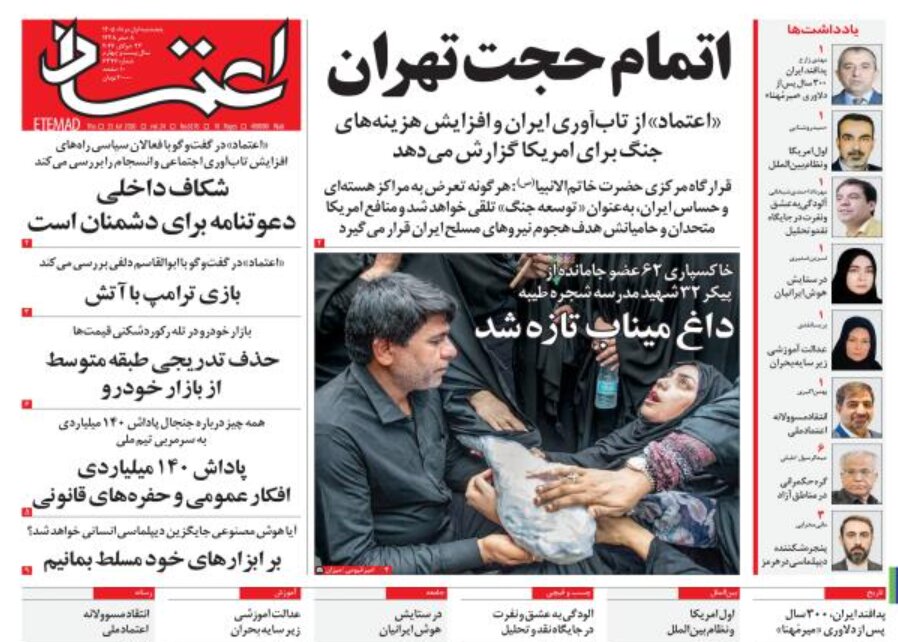
The Tehran Times is not a neutral aggregator; it functions here as a curated digest of how the Iranian commentariat wants the country's situation to be understood. By gathering five papers spanning the reformist to the conservative-security spectrum, the framing converges on a single message: external threats from the United States and Israel are real and ongoing, but Iran's primary asset is internal unity, and its military actions are deliberate, calibrated, and increasingly effective. Javad Emam, spokesperson for the Reform Front, sets the political tone in Etemad by arguing that "what can guarantee the country's security, stability, and authority more than anything else is not political or media commotion, but rather the preservation of national unity." For a reformist voice to echo what is essentially a national-security argument signals that even Iran's internal critics are subordinating factional disputes to wartime cohesion.
The US–Saudi Nuclear Pact and the Riyadh Variable
The Shargh analysis is the most diplomatically loaded section. A US–Saudi civilian nuclear agreement is described as a stabilizing step in Washington–Riyadh relations strained by the war with Iran, with the nuclear track partly serving as a deterrent against Tehran. Crucially, the paper notes that Saudi Arabia still sought talks with Iran after relying on US-supplied interceptors during Iranian strikes, and reminds readers that the two countries restored ties in 2023 through Chinese mediation. This is significant because it implicitly frames Beijing, not Washington, as the durable diplomatic broker in the Gulf. For Iran, a US–Saudi nuclear deal reshapes the regional balance even if the immediate war is the dominant concern.
Escalation by Design, Not Accident
The Farhikhtegan, Javan, and Arman-e-Melli pieces, taken together, outline Tehran's theory of victory. Farhikhtegan catalogs what it calls a series of military surprises: more accurate missile systems, higher penetration rates against air defenses, real-time intelligence enabling strikes on launchers in Kuwait, and a sequenced strangulation of regional supply logistics. The closure of the Strait of Hormuz was followed by the shutdown of the Fujairah bypass, then Oman's Duqm port, and now Aqaba, with Yemen preparing to extend pressure into the Red Sea. Javan frames IRGC strikes on Iraqi Kurdistan as a second front aimed at the "Zionist regime's" longstanding presence and Kurdish separatist groups on Iran's western border. Arman-e-Melli is the most theoretically explicit, calling Iran's approach a "step-by-step" model applied since the Ramadan war and even the earlier 12-day conflict, and identifying it with the escalation-ladder logic. The combined message is that Iran is not improvising; it is running a deliberate ladder of pressure designed to deny the adversary the ability to escalate in kind.
Key points
- Reform Front spokesperson Javad Emam argues that national unity, not political noise, is Iran's strongest asset against US and Israeli pressure.
- Shargh reads the imminent US–Saudi civilian nuclear agreement as a stabilizing move for Washington–Riyadh ties, partly aimed at deterring Iran.
- Farhikhtegan claims Iran's recent strikes showed greater accuracy, higher air-defense penetration, and a systematic blockade of regional supply routes including Hormuz, Fujairah, Duqm, and Aqaba.
- Javan frames IRGC attacks on Iraqi Kurdistan as a second front targeting Israeli activity and Kurdish separatist groups on Iran's western border.
- Arman-e-Melli describes Iran's approach as a deliberate 'step-by-step' escalation-ladder strategy applied across multiple recent confrontations.
If the calls for national cohesion take hold and Iran's calibrated escalation succeeds, Tehran could emerge from the confrontation with strengthened internal legitimacy and a higher regional bargaining position, potentially reopening diplomatic channels through partners like China and Saudi Arabia on more favorable terms.
The same sequenced escalation that the papers praise risks drawing in additional regional actors and deepening the economic costs of disrupted Gulf and Red Sea shipping. A US–Saudi nuclear pact, even a civilian one, could also dilute Iran's deterrent leverage in the longer term, while internal cohesion may prove fragile if the war's economic toll on ordinary Iranians continues to mount.