FM, Sudanese finance minister discuss reconstruction efforts
Egyptian Foreign Minister Badr Abdelatty met with Sudanese Finance Minister Gibril Ibrahim to discuss expanding economic cooperation and supporting Sudan's reconstruction efforts. Talks focused on financial policies, increasing trade and investment, and rehabilitating inf…
Intelligence analysis by Gemini 2.5 Flash
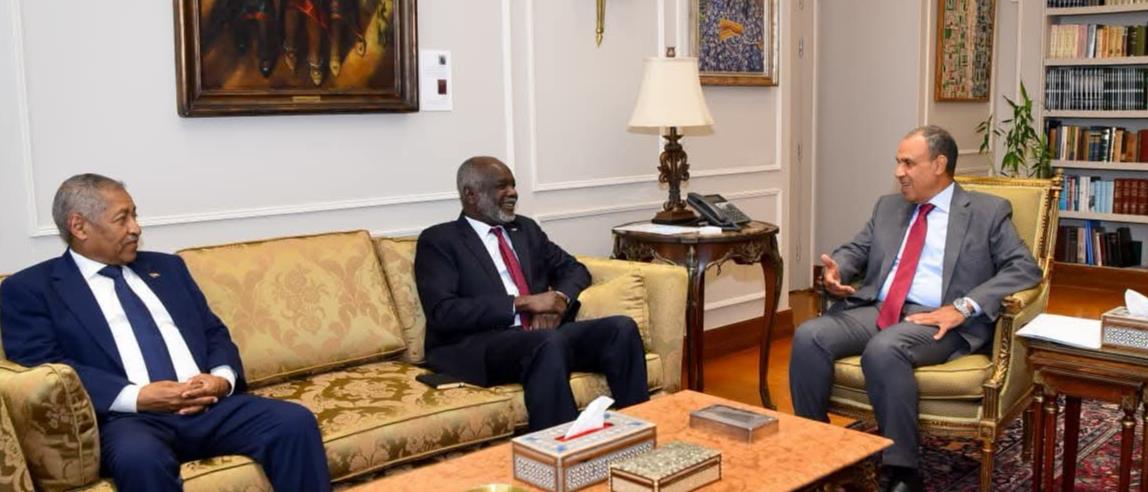
Egypt is actively engaging with Sudan to bolster its post-conflict recovery, offering expertise and support across various economic and infrastructure sectors. The discussions underscore Egypt's commitment to Sudan's stability and unity, aiming to foster a Sudanese-led political settlement and reject any attempts at division.
Imagine your neighbor's house got really messy and broken after a big storm. Egypt, like a good friend, is offering to help Sudan clean up and fix things, especially the roads, hospitals, and how they buy and sell things. They want to make sure Sudan stays strong and together, so everyone can live safely and happily again.
Analysis
The meeting between Egyptian Foreign Minister Badr Abdelatty and Sudanese Finance Minister Gibril Ibrahim on August 23, 2026, signals a concerted effort by Egypt to support Sudan's recovery and stability. This engagement is crucial given Sudan's ongoing internal challenges and the broader regional implications of its stability. Egypt's offer of expertise in infrastructure, medical, and pharmaceutical sectors underscores a practical approach to aid, moving beyond mere rhetoric to tangible support.
Gibril Ibrahim
Sudanese Finance and Economic Planning Minister Gibril Ibrahim's participation in these talks highlights Sudan's urgent need for international and regional assistance in rebuilding its economy and infrastructure. The discussions focused on critical areas such as financial policies, trade, and investment, which are foundational for long-term economic recovery. Addressing obstacles to bilateral commerce is a key step towards fostering a more robust economic relationship between the two nations, potentially unlocking significant growth opportunities for both.
Egypt's emphasis on rehabilitating Sudan's infrastructure, particularly roads and transport, is vital for improving internal connectivity and facilitating trade. A functional infrastructure network is essential for economic activity, allowing goods and services to move more efficiently and supporting the delivery of humanitarian aid. Furthermore, cooperation in the medical and pharmaceutical sectors is critical for public health, especially in a country recovering from conflict, ensuring access to essential healthcare services and supplies.
Alamein Forum
The mention of the first Africa Business Summit, to be held as part of the Alamein Forum for Business in Africa, provides a strategic platform for broader economic engagement. Encouraging Sudanese participation in this event demonstrates Egypt's intent to integrate Sudan into regional economic initiatives. Such forums can facilitate networking, attract investment, and foster partnerships that are crucial for Sudan's economic diversification and growth, extending beyond bilateral aid to sustainable development opportunities.
This summit could serve as a catalyst for greater economic and investment cooperation not only between Egypt and Sudan but also with other African nations. By showcasing investment opportunities and fostering business connections, the Alamein Forum aims to stimulate private sector involvement in reconstruction and development efforts. This approach aligns with a vision of regional self-reliance and collective prosperity, leveraging shared resources and expertise to address common challenges.
Sudan’s Unity
Foreign Minister Abdelatty's reiteration of Egypt's unwavering support for Sudan's unity, sovereignty, territorial integrity, and national institutions is a significant diplomatic stance. This position directly addresses the internal fragmentation and external pressures that Sudan has faced, emphasizing the importance of a unified and stable state. Rejecting attempts to divide the country or establish parallel entities underscores a commitment to a singular, legitimate government capable of leading the nation's recovery.
The call for a Sudanese-led political settlement is crucial for ensuring that any resolution is sustainable and genuinely reflects the aspirations of the Sudanese people. This approach respects national sovereignty while advocating for a process that preserves the country’s resources and meets the populace's desire for security and stability. Egypt's diplomatic efforts thus aim to reinforce the foundational principles necessary for Sudan to emerge stronger from its current challenges, with regional backing for its integrity.
Key points
- Egyptian FM Badr Abdelatty and Sudanese Finance Minister Gibril Ibrahim discussed expanding economic cooperation and reconstruction efforts.
- Talks focused on financial policies, increasing trade and investment, and removing bilateral commerce obstacles.
- Cooperation will target rehabilitating Sudan’s infrastructure, particularly roads, transport, and the medical/pharmaceutical sectors.
- Egypt offered its experience and capabilities to contribute to Sudan’s early recovery and reconstruction.
- Egypt reiterated support for Sudan’s unity, sovereignty, and national institutions, rejecting attempts to divide the country.
If these discussions translate into concrete actions, Sudan could see significant improvements in its infrastructure, economy, and public services, supported by Egypt's expertise and resources. Enhanced bilateral trade and investment could stimulate economic growth, leading to greater stability and improved living standards for the Sudanese people.
Despite Egypt's commitment, the success of these reconstruction efforts heavily depends on the political stability within Sudan and the effective implementation of agreed-upon measures. Ongoing internal conflicts or a lack of sustained political will could hinder progress, making it difficult to realize the full potential of the proposed cooperation.