For Many Arbaeen Pilgrims, Every Step Honors Martyred Ayatollah Khamenei
Millions of Arbaeen pilgrims march through Iraq to honor the martyred Leader of the Islamic Revolution, Ayatollah Khamenei, and the Iraqi Resistance, despite the US-Israeli war on Iran.
Intelligence analysis by Llama
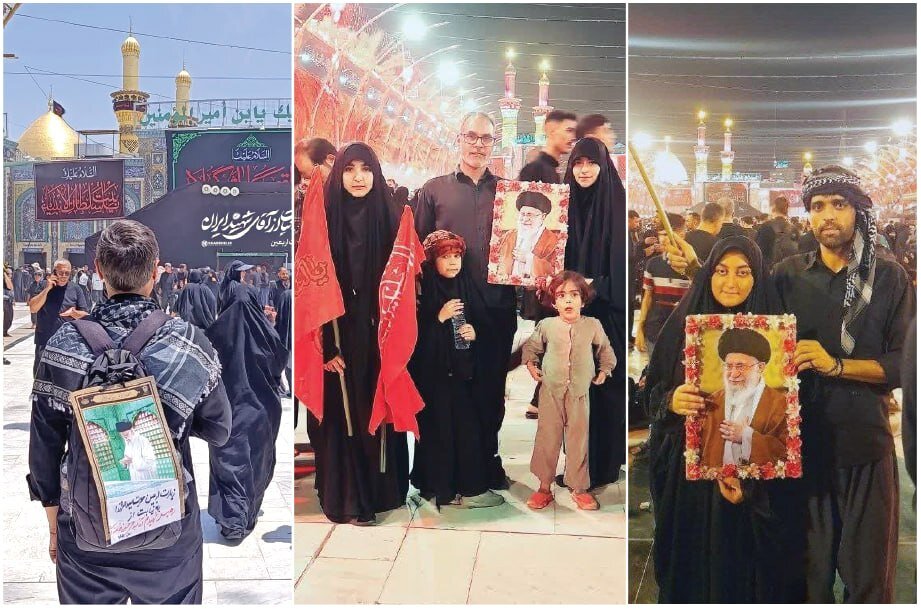
The Arbaeen pilgrimage has become a powerful symbol of resistance and a testament to the strength of the Iranian and Iraqi peoples. The march has attracted millions of visitors, who are drawn by the 'magnetic attraction' of the pilgrimage and the sense of solidarity and shared sacrifice.
Imagine a big group of people walking together to honor a leader who was killed. They're not just walking for themselves, but for all the people who were hurt or killed in the war. It's like a big chain of people holding hands, and each person is connected to the others. This chain is strong because it's made up of people who care about each other and want to help each other.
Analysis
The Unbroken Chain at Pole 553
At Pole 553, beside the Haj Qasem Soleimani mawkib, a red flag dominates the skyline. In Shia tradition, a red banner signifies blood demanding justice. There is no roster. No one is paid to hold it. An Iranian woman, sweat cutting lines through the dust on her face, passes the heavy pole to an Iraqi grandfather leaning on a cane. A seven-year-old girl stretches to keep the fabric from sagging. Daytime temperatures approach 50 degrees Celsius. The asphalt hits 70. Yet organizers confirm the flag has not touched the ground for a single second since the pilgrimage began.
The Magnetic Pull
Strategists cannot decode Arbaeen because it humiliates the assumptions of neoliberal governance. You cannot sanction a hospitality network built entirely on faith. Millions are fed, sheltered, and treated medically without a central bureaucracy or an IMF loan. This living civilizational network operates on selfless sacrifice. Years ago, Ayatollah Khamenei mapped this exact phenomenon, describing the 'Husseini magnetic attraction' that drew Jabir ibn Abdullah, a trusted companion of the Prophet Muhammad (PBUH) and the first pilgrim to visit Karbala on Arbaeen, from Medina across the centuries. Today, his own martyrdom has fused with that ancient gravity, transforming a historical pilgrimage into an irresistible civilizational force.
A Historic Reversal of the Ba'athist Legacy
The martyred leader taught that Iran and Iraq are joined at the soul by this love. In a handwritten note left for students preparing for the road, he urged them to anchor their steps in the uncompromising purpose of the Master of the Martyrs, Imam Hussein (AS), a total rejection of illegitimate tyranny. This year's Arbaeen march is the living execution of that directive. Millions are writing history with every blistered step across the asphalt, proving that no empire's warplanes can break a civilization that refuses to kneel.
Key points
- Millions of Arbaeen pilgrims march through Iraq to honor the martyred Leader of the Islamic Revolution, Ayatollah Khamenei.
- The pilgrimage has become a powerful symbol of resistance and a testament to the strength of the Iranian and Iraqi peoples.
- The march has attracted millions of visitors, who are drawn by the 'magnetic attraction' of the pilgrimage and the sense of solidarity and shared sacrifice.
- The Arbaeen pilgrimage is a significant event in the region, showcasing the strength and resilience of the Iranian and Iraqi peoples in the face of US-Israeli aggression.
- The pilgrimage has shown that even in the face of war and aggression, the Iranian and Iraqi peoples can come together and show their strength and resilience.
The Arbaeen pilgrimage has shown that even in the face of war and aggression, the Iranian and Iraqi peoples can come together and show their strength and resilience. This could be a turning point in the region, where the people take control of their own destiny and refuse to be controlled by external forces.
The US-Israeli war on Iran could lead to further escalation and more violence, which could put the lives of millions of people at risk. The Arbaeen pilgrimage is a powerful symbol of resistance, but it could also be a target for further aggression.