Iran, Pakistan forge path to $10b trade milestone as joint committee meets in Islamabad
Iran and Pakistan have convened the 19th session of their Joint Trade Committee in Islamabad, aiming to reach a $10 billion annual trade target. The two-day meeting will cover finalizing a Free Trade Agreement, resolving logistical challenges, and promoting private sector…
Intelligence analysis by Llama
Iran and Pakistan are working towards a $10 billion annual trade target, with the 19th Joint Trade Committee meeting in Islamabad to discuss a Free Trade Agreement and logistical challenges. The two countries aim to strengthen their economic ties and promote private sector cooperation.
Iran and Pakistan are working together to increase their trade. They want to make it easier for businesses to move goods between the two countries and to make more money. This will help both countries and also help other countries in the region.
Analysis
A $10B Vote of Confidence
The 19th session of the Iran-Pakistan Joint Trade Committee has convened in Islamabad, marking a significant step towards achieving a $10 billion annual trade target. This ambitious goal is not only a testament to the strong economic ties between the two countries but also a reflection of their shared vision for regional trade and economic cooperation.
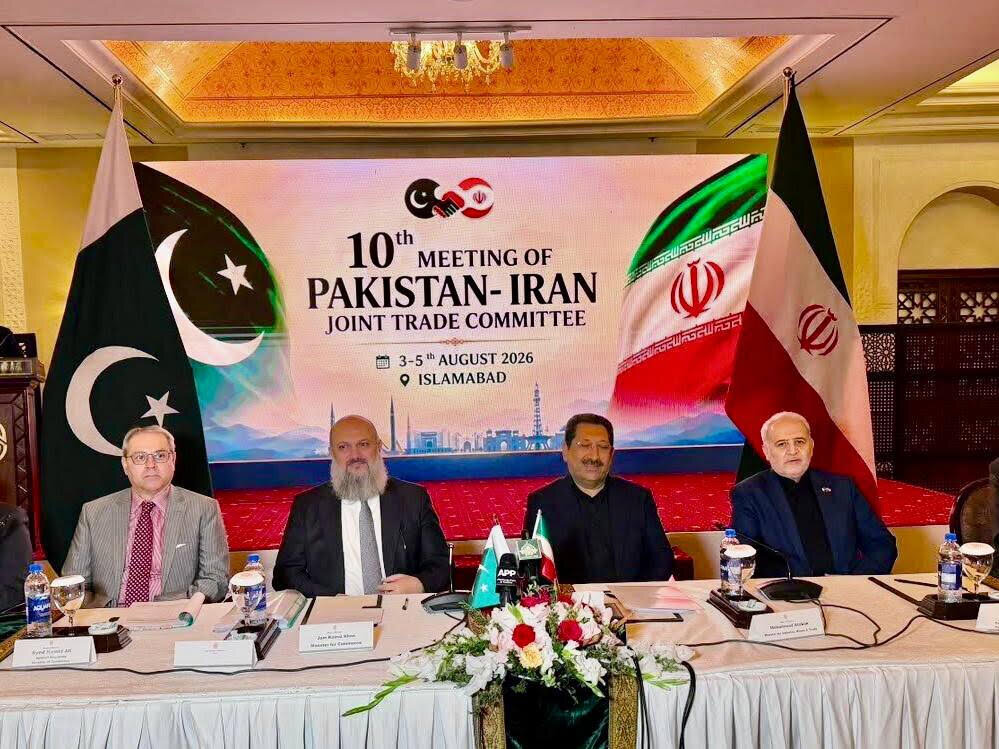
The two-day meeting, co-chaired by Iran's Minister of Industry, Mining and Trade, Seyyed Mohammad Atabak, and Pakistan's Commerce Minister, Jam Kamal Khan, represents the most comprehensive bilateral trade negotiation in recent years. The agenda is packed with critical issues, including finalizing a long-awaited Free Trade Agreement, resolving urgent logistical challenges at ports and border crossings, and promoting private sector cooperation.
Minister Atabak emphasized that the strategic policy of Iran is the comprehensive development of cooperation with neighboring and aligned countries, particularly Pakistan. He noted that annual bilateral trade has already reached approximately $3 billion, demonstrating the real and extensive capacity that exists between the two economies. Pakistan's Commerce Minister Jam Kamal Khan echoed this sentiment, declaring: "We are determined to finalize the Free Trade Agreement between Pakistan and Iran." Khan emphasized that the longstanding and brotherly relations between the two countries serve as a strong foundation for continuing friendship and neighborliness on the path to upgrading comprehensive cooperation.
Why Cursor?
The strengthening of Iran-Pakistan economic ties carries significant implications beyond bilateral relations. Enhanced transit cooperation could provide the groundwork for connecting European and Asian markets, positioning both countries as pivotal nodes in East-West trade corridors. Pakistan's ports—Karachi, Qasim, and Gwadar—could serve as complementary routes for re-exporting Iranian goods and supplying raw materials needed by industries across the region.
The Road Ahead
As the 19th Joint Trade Committee continues its work, the focus will be on resolving the outstanding issues and finalizing the Free Trade Agreement. The private sector will play a crucial role in this process, with the Iran Chamber of Commerce, Industries, Mines and Agriculture delegation scheduled to hold meetings with members of the Islamabad Chamber of Commerce and Pakistani private sector. The successful implementation of the agreement will not only boost bilateral trade but also have a positive impact on regional trade and economic cooperation.
The path to achieving the $10 billion trade target is ambitious, but with the political will and commitment from both sides, it is entirely feasible. The removal of existing obstacles, conclusion of the Free Trade Agreement, establishment of direct financial and banking links, and reduction of cumbersome regulations and bureaucratic red tape are all crucial steps towards achieving this goal. The successful implementation of the agreement will not only boost bilateral trade but also have a positive impact on regional trade and economic cooperation.
Key points
- Iran and Pakistan are working towards a $10 billion annual trade target.
- The 19th Joint Trade Committee meeting in Islamabad will cover finalizing a Free Trade Agreement and resolving logistical challenges.
- The two countries aim to strengthen their economic ties and promote private sector cooperation.
- The successful implementation of the agreement will have a positive impact on regional trade and economic cooperation.
If the Iran-Pakistan Free Trade Agreement is successfully implemented, it could lead to a significant increase in bilateral trade, with both countries benefiting from the increased economic activity. This could also have a positive impact on regional trade and economic cooperation, with other countries in the region potentially following suit.
If the Iran-Pakistan Free Trade Agreement is not successfully implemented, it could lead to a delay in achieving the $10 billion trade target, which could have a negative impact on the economies of both countries. This could also lead to a decrease in regional trade and economic cooperation, with other countries potentially losing interest in the agreement.