Pope Leo XIV details family's slavery history in interview with Tom Llamas
In his first on-camera interview, Pope Leo XIV — the first American pope — told NBC's Tom Llamas that his maternal ancestors included both enslaved people and slaveowners.
Intelligence analysis by Llama
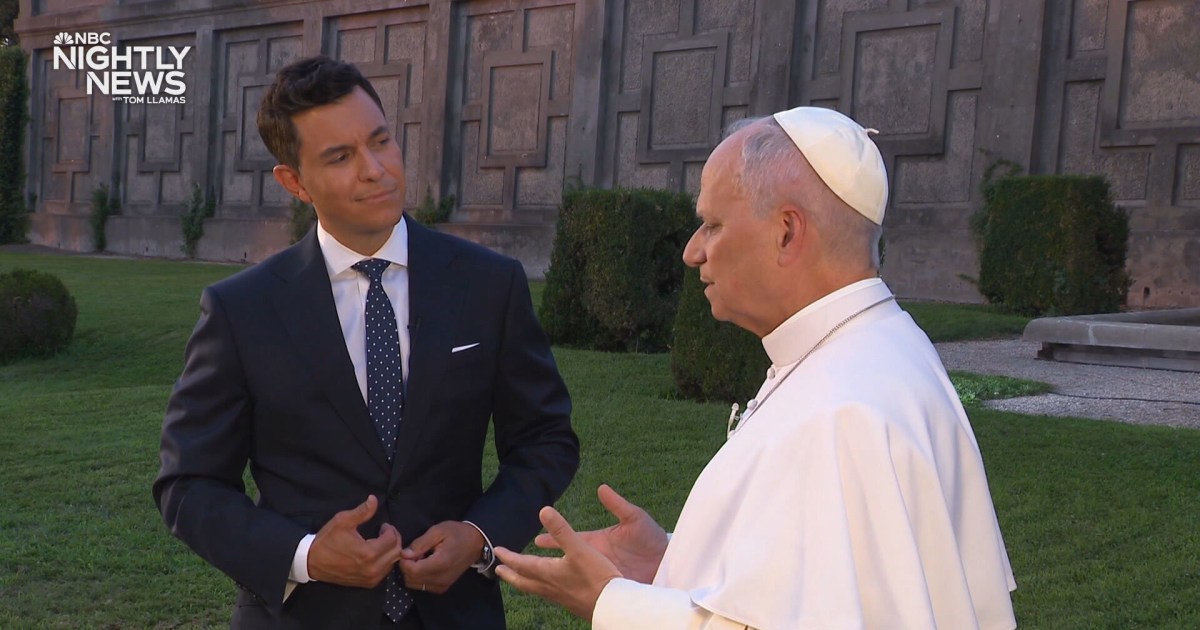
Pope Leo XIV, the first American pontiff, publicly disclosed his family's tangled ties to slavery, saying both slaves and slaveowners appear on his mother's side. The interview, his first on camera, aired on NBC Nightly News.
The new pope is the first one ever from America, and he sat down for a TV interview to talk about his family. He said that on his mom's side of the family, some people were slaves and some were the people who owned slaves, kind of like a family tree that has both a kid and the grown-up who made the kid sit in time-out.
Analysis
A Pontiff's First American Confession
The interview marks a notable moment simply because it happened on camera. Pope Leo XIV, the first American to lead the Roman Catholic Church, sat down with NBC Nightly News' Tom Llamas for what the network described as the pope's first on-camera interview. By choosing an American outlet and an American anchor for that debut, the pontiff signaled that his U.S. identity — and the questions that come with it — is not something he intends to keep at arm's length. The decision to make a slavery disclosure in that very first sit-down raises the profile of the conversation considerably, both inside the Church and across a country still debating how to teach and remember its slave past.
A Family Tree With Two Sides
The most concrete revelation was a single, carefully worded sentence: "I come from a family that my grandparents were immigrants. On my mother's side we have people who were both slaves and slaveowners." That formulation, drawn from the segment itself, is striking in its evenness. Pope Leo XIV did not frame his ancestors as either victims or perpetrators, but as both — a structure that mirrors the genealogical reality many white Americans only recently began to confront through DNA testing and family-history research. By saying it plainly, the pope puts his own lineage inside a national reckoning that has moved from university history departments into boardrooms, state legislatures, and church pulpits.
Why the Church Context Matters
The timing of the disclosure lands against a backdrop of institutional pressure. The Catholic Church in the United States has faced its own scrutiny over historical entanglements with slavery, including the 2018 Georgetown University report that documented the sale of 272 enslaved people by the Jesuit order in 1838 to keep the school solvent. A sitting American pope's willingness to name his family's role — however personally removed — gives the hierarchy a living example to point to when bishops and priests are asked to address slavery's legacy in their own dioceses. It also positions the new pontiff to speak credibly about racial justice, immigration, and historical memory, themes NBC noted he intends to expand on during the full Nightly News broadcast.
Key points
- Pope Leo XIV discussed his family's slavery history in his first on-camera interview, with NBC's Tom Llamas.
- He said his maternal ancestors included both enslaved people and slaveowners, and that his grandparents were immigrants.
- He is the first American to serve as pope, a milestone NBC highlighted throughout the segment.
- The interview aired on NBC Nightly News, with a longer conversation scheduled for the full broadcast.
- The disclosure comes as the U.S. Catholic Church continues to grapple with its own institutional links to slavery.
By naming his family's ties to slavery on camera, the pope could give American Catholics and other U.S. faith communities a more credible platform to discuss racial history and reconciliation, lending moral weight to local efforts at acknowledgment and repair.
The disclosure also risks reopening scrutiny of how thoroughly the Vatican itself has confronted its own historical ties to slavery, and the pope's personal admission may be used to pressure the Church on reparations, apologies, or institutional reform it is not prepared to undertake.