The Emperor Has No Ludus Magnus
A satirical essay says Trump’s planned UFC event echoes Roman spectacle, but it misses the broader civic, medical, and political ambitions of ancient gladiator culture.
Intelligence analysis by GPT-5.4 Mini
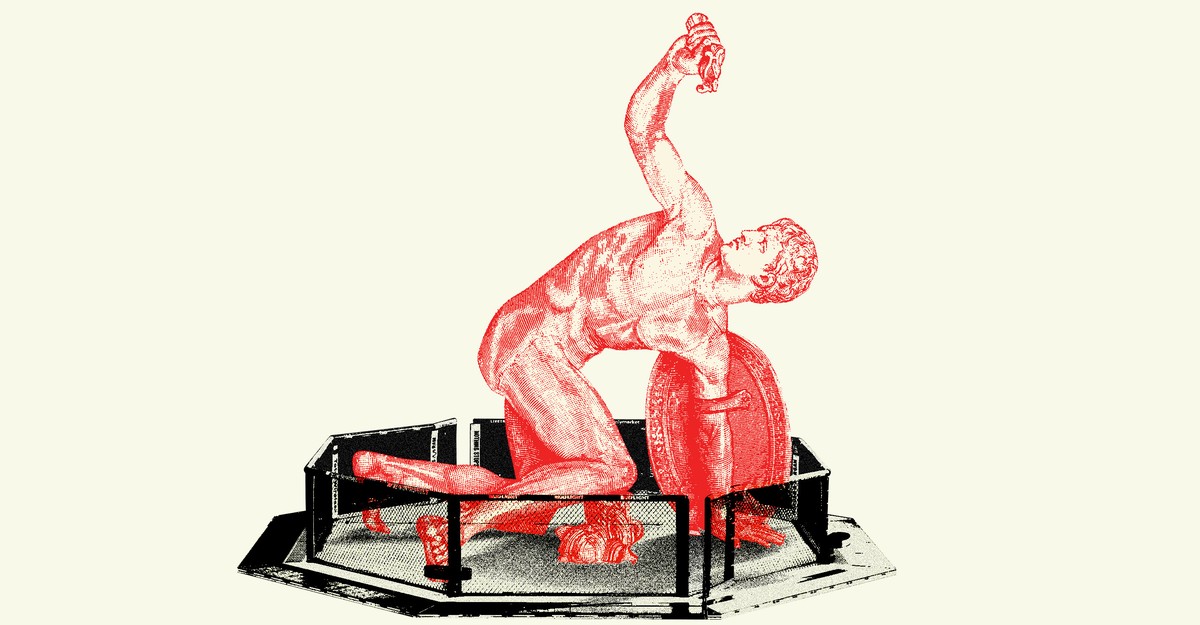
The piece mocks a Trump-era cage fight at the White House as grand in appearance but narrow in imagination. It argues that Rome linked spectacle to training, mercy, public health, and urban design, while this event does not.
The article says Trump is putting on a big fight show, like an emperor in old Rome. But it jokes that he only copied the loud part and forgot the rest, like schools, doctors, and rules that made the old shows part of a whole city.
Analysis
The spectacle
The Atlantic essay treats the planned UFC event at the White House as a deliberately Roman-style display: a steel dome, an octagonal cage, dignitaries in view, and Trump seated like an emperor. But the author’s point is not just that the event is extravagant. It is that it is strangely limited in scope. In the Roman model, gladiatorial combat was tied to city life, training institutions, public ceremony, and even state power. Here, by contrast, the spectacle is reduced to one fight card and a lot of symbolism.
What Rome had that this does not
The essay argues that ancient gladiator culture came with infrastructure. It had training schools, nearby facilities, and ritualized movement from school to arena. The author imagines how easy it would be to build a modern equivalent near the White House, complete with dorms, classrooms, and trauma care. That is part of the satire: if the administration is going to borrow from Rome, the essay suggests, it is ignoring the rest of the package.
The piece also connects gladiatorial culture to clemency and medicine. Roman rulers sometimes paired violent displays with pardons or symbolic acts of mercy. Meanwhile, gladiators received serious medical care because they were valuable investments. The essay folds in references to Trump’s pardon record, his long-promised health care reforms, and the presence of Robert F. Kennedy Jr. as health secretary to underline the contrast between showmanship and substance.
The larger critique
The closing complaint is that the White House has settled for a one-night spectacle rather than the larger social and political architecture that once surrounded public games. The author’s final jab is that the event may be impressive, but it falls short of the scale Trump seems to want: something the world has never seen.
Key points
- The essay compares Trump’s planned UFC event at the White House to Roman gladiatorial spectacle.
- It says the administration is copying the violence and pageantry but not the surrounding civic institutions.
- The author highlights missed opportunities for training facilities, pardons as ritual mercy, and health care parallels.
- The piece uses satire to argue that the event is more show than system.
- It frames the whole project as grand-looking but narrow in ambition.
If the event stays limited to a one-time spectacle, it may remain mostly symbolic rather than becoming a deeper institutional shift. The piece suggests there is still room for public debate about what kind of leadership and public theater Americans want from the White House.
The essay warns that the event could normalize more empty pageantry in place of serious policy work. If the administration keeps favoring spectacle over substance, the result may be more political theater without the broader civic benefits or safeguards the article associates with Rome.