Three firefighters killed on Crete and in mainland Greece as Europe battles wildfires
Three Greek firefighters died battling wildfires on Crete and the mainland as a fourth heatwave fuels blazes across southern Europe, with Spain's largest wildfire on record stabilized near Madrid.
Intelligence analysis by Llama
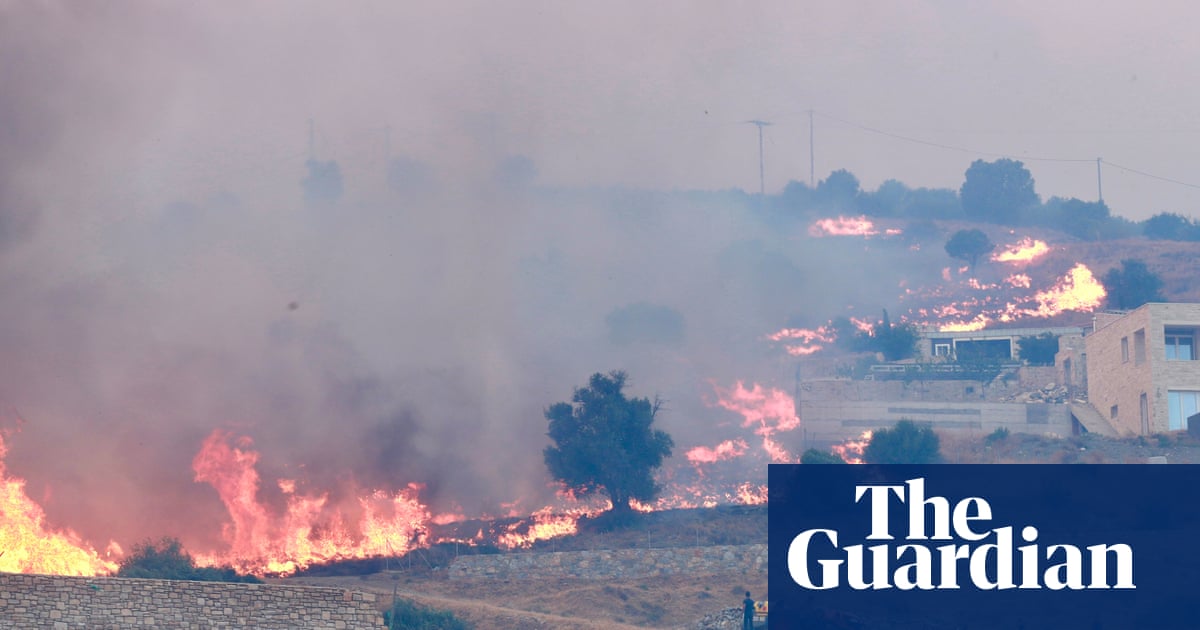
Europe's fourth heatwave of the summer is fueling an arc of wildfires from Spain to Turkey. Three Greek firefighters died, Spain's largest-ever wildfire has been stabilized near Madrid, and the French Bordeaux blaze continues. Over 330,000 people have been displaced.
Europe is having a really hot summer that's been turning forests into kindling. Big fires are burning in Spain, France, Greece, and Turkey, and three firefighters in Greece died fighting them. Hundreds of thousands of people had to leave their homes, but other European countries are sending planes and crews to help — like neighbors pitching in when a friend's house is on fire.
Analysis
A Continent-Wide Arc of Fire
The blazes now burning across southern Europe form what the Guardian describes as "an arc" stretching from the Atlantic coast through France, Spain, and Italy to the eastern Mediterranean and Turkey. The geography matters: this is not a series of isolated incidents but a connected weather event, driven by the fourth heatwave of a summer that has already broken records.
Temperatures hit 38C in Bordeaux and 37C in Madrid on Wednesday. European Forest Fire Information System data shows France has burned a record-breaking area, while France and Spain have both recorded record-breaking numbers of fires for this time of year. The repetition is the story: dried vegetation from earlier heatwaves has turned forests and shrubland into tinderboxes, meaning each new wave of hot weather and strong winds can reignite what was thought to be contained.
The human cost hit hardest in Greece, where the fire department confirmed that two firefighters "fell heroically in the line of duty" on Crete, with a third killed on the south of the mainland. The loss of three first responders in a single day underscores how the shifting fire behavior — faster, more aggressive, harder to predict — is outpacing even experienced crews.
Spain's Unprecedented Mobilization
Near Madrid, the scale of the response crossed a threshold the country has never seen. Prime Minister Pedro Sánchez said the situation was improving but stressed that the wildfire had been raised to "operational level 3," the first time in Spanish history the national government has taken over disaster response from regional authorities.
The interior minister, Fernando Grande-Marlaska, said the blaze — Spain's largest wildfire on record — had been "technically stabilised" after overnight work by dozens of ground crews. But "stabilised" is not "extinguished," and a separate fire near València remained out of control. Sánchez framed the next 12 hours as decisive, a window where hot, windy conditions could either allow crews to consolidate gains or allow the fire to break out again.
The Madrid fire is the most visible symbol of a wider Spanish crisis. Across the country, more than 134 personnel and 41 vehicles have arrived from Portugal, with a Serbian Super Puma helicopter and additional ground crews expected midweek. Some evacuees who returned home near Madrid found only charred remains — one 74-year-old pensioner told AFP he had "no money, no documents, no home."
EU Solidarity Under Strain
European Commission President Ursula von der Leyen framed the response as a test of continental cohesion. "As the fires in France and Spain continue to ravage, European solidarity knows no limit," she posted, noting that Romania and Greece had extended mutual aid missions and that Poland would join from Saturday.
The numbers are concrete: seven planes and four helicopters sent to France from countries as far away as Sweden and Turkey; six planes from Greece, Italy, and Turkey to Spain. EU officials have warned that wildfires could still be burning in November — a forecast that hints at a fire season longer than the response architecture was designed for.
The broader context, the article notes, is that carbon pollution is heating Europe "twice as fast as the global average." The current crisis is not an anomaly to be survived but a stress test of systems built for a climate that no longer exists. What looks like an emergency response is, increasingly, the new baseline.
Key points
- Three Greek firefighters died on Crete and the mainland, with two described by authorities as having 'fallen heroically in the line of duty'
- Spain's largest wildfire on record has been 'technically stabilised' near Madrid after being raised to 'operational level 3' — a first in Spanish history
- More than 330,000 people have been displaced across southern Europe, with evacuations now being lifted near Bordeaux, Madrid, and València
- The fourth heatwave of the summer brought 38C in Bordeaux and 37C in Madrid, with France and Spain both reporting record-breaking fire numbers for the date
- The EU has deployed aircraft and personnel from Sweden, Turkey, Greece, Italy, Portugal, Romania, Serbia, and Poland in an unusually broad mutual-aid operation
Spain's largest wildfire on record has been "technically stabilised" near Madrid, evacuation orders are beginning to be lifted, and a calm night helped French crews contain flare-ups in Gironde. The EU is actively mobilizing cross-border aid, with Romania and Greece extending missions and Poland joining on Saturday, suggesting that continental coordination can bend the curve of this fire wave.
Repeated heatwaves have desiccated vegetation so thoroughly that fires can restart in areas already stabilized, and EU officials warn blazes could still be burning in November. The climate crisis is heating Europe "twice as fast as the global average," meaning the response architecture built for a milder climate may be structurally insufficient. The deaths of three Greek firefighters in a single day illustrate that fire behavior is outpacing even experienced crews.