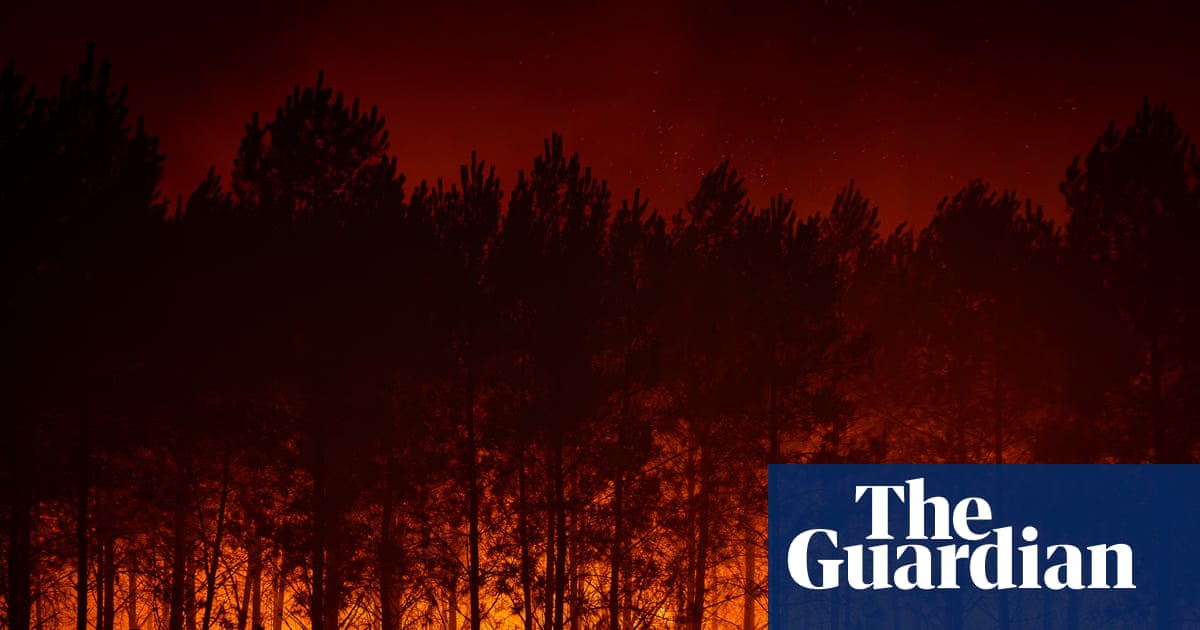
Wildfires: The ominous 'fire clouds' or 'pyrocumulonimbus' seen in France for the first time
French firefighters are grappling with immense fire clouds, known as pyrocumulonimbus clouds, created by extreme wildfires in southwest France. These clouds create their own wind and even lightning that can spark fresh blazes.
Intelligence analysis by Llama
France is experiencing its first pyrocumulonimbus clouds, which are created by extreme wildfires and can exacerbate already dangerous conditions. Firefighters are struggling to bring a forest inferno under control before a new heatwave descends on the country.
Imagine a big cloud that forms above a wildfire. This cloud can create its own wind and even lightning that can spark fresh blazes. It's like a giant storm that's hard to predict and control. Firefighters in France are struggling to deal with these massive clouds, which are a new consequence of human-caused climate change.
Analysis
A New Threat for Firefighters
The recent wildfires in southwest France have brought a new challenge for firefighters: pyrocumulonimbus clouds. These massive clouds are created by extreme wildfires and can create their own wind and even lightning that can spark fresh blazes. The phenomenon is new to France, and it is a consequence of human-caused climate change.
According to French researcher Jean-Baptiste Filippi, who studies wildfires, pyrocumulonimbus clouds are a common phenomenon in Portugal, California, and Australia, where firefighters are more used to them. However, in France, they are quite rare and pose a significant threat to firefighters and the environment.
The biggest challenge for firefighters is the unpredictability of pyrocumulonimbus clouds. Weather services can predict thunderstorms, but because these storms are located directly above a fire, it is impossible to know the fire's exact location in advance. This makes it difficult for firefighters to prepare and respond to the situation.
The fire in France's southwest Gironde region started with northerly winds, then westerly, then southerly, then easterly, then back again to the south, then the west... On top of that, there is this potential energy in the atmosphere which meant that, locally, the convection column sucked up the embers and carried the fire further afield. The local conditions became catastrophic and the rate of the fire's spread was staggering.
A Consequence of Climate Change
The phenomenon of pyrocumulonimbus clouds is a new consequence of human-caused climate change. As the planet warms, heatwaves become more frequent, and this leads to more extreme wildfires. The combination of thunderstorms and wildfires creates a perfect storm that can lead to catastrophic consequences.
According to Filippi, the conditions that lead to pyrocumulonimbus clouds are predictable, but the exact location of the fire is not. This makes it difficult for firefighters to prepare and respond to the situation.
The Road Ahead
The recent wildfires in France have highlighted the need for better preparedness and response to pyrocumulonimbus clouds. Firefighters need to be trained to deal with these massive clouds, and the public needs to be aware of the risks associated with them. Additionally, the government needs to take action to reduce the impact of climate change and prevent more extreme wildfires in the future.
Key points
- Pyrocumulonimbus clouds are a new phenomenon in France, created by extreme wildfires and heatwaves.
- These clouds can create their own wind and even lightning that can spark fresh blazes.
- Firefighters in France are struggling to deal with these massive clouds, which are a new consequence of human-caused climate change.
- The government needs to take action to reduce the impact of climate change and prevent more extreme wildfires in the future.
If the government takes action to reduce the impact of climate change, we might see a decrease in the frequency and severity of wildfires. This could lead to fewer pyrocumulonimbus clouds and a safer environment for firefighters and the public.
If the government doesn't take action to reduce the impact of climate change, we might see an increase in the frequency and severity of wildfires. This could lead to more pyrocumulonimbus clouds and a greater risk to firefighters and the public.