Cut cost of loans for solar panels on UK homes, ministers urged
A report suggests the UK government should offer "solar bonds" to fund low-interest loans for home solar panel installations, making clean energy more accessible and reducing household bills.
Intelligence analysis by Gemini 2.5 Flash Lite
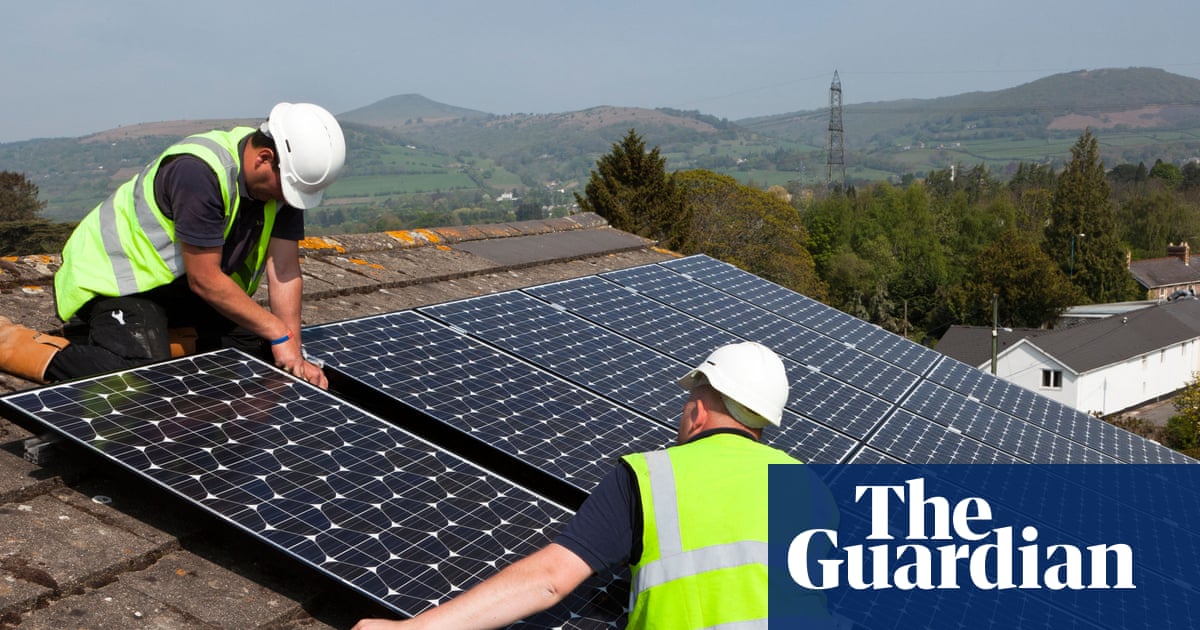
The Common Wealth thinktank proposes "solar bonds" as a government-backed retail investment product to finance solar panel installations for households. This would enable lower interest rates on loans, making panels affordable for more people and potentially saving them hundreds annually on energy bills.
Imagine your house could make its own electricity from the sun, but it costs a lot to buy the special panels. This idea is like the government asking people with extra money to lend it to others to buy these panels, but at a much lower cost than a bank would charge. So, more families can get sun-power, save money on their bills, and the people who lent the money get a little bit back.
Analysis
Solar Bonds
The Common Wealth thinktank's proposal centers on the creation of "solar bonds," a retail investment product that the government could issue. Modeled after existing national savings investments or premium bonds, these bonds would allow individuals with spare capital to invest, receiving interest payments in return for funding the purchase and installation of solar panels for other households. This mechanism aims to bypass the high interest rates typically associated with commercial loans for solar installations, which often negate the energy bill savings for a significant period. By offering a state-backed financial instrument, the government could facilitate a more equitable distribution of clean energy benefits.
Lower Interest Rates
A key benefit of the proposed solar bond scheme is the potential to drastically reduce the cost of financing for homeowners. The report estimates that households could access loans at approximately half the current market interest rates, which hover around 9% to 10%. This reduction in financing costs is projected to save households around £250 per year on their energy bills. Furthermore, the loans, designed to run for up to 25 years, could be repaid through a small addition to the standing charge on energy bills. Crucially, these loans would be attached to the property, meaning that if a home is sold, the loan would transfer to the new owner, simplifying the process and ensuring continuous repayment without complex means-testing. This feature is seen as a secure method for loan repayment, given the historically low default rates on standing charges.
Broader Economic and Political Implications
Beyond direct financial savings for households, the initiative carries broader economic and political implications. The government's involvement in issuing solar bonds could also drive down the overall installation costs of solar panels by increasing demand and potentially standardizing processes. This aligns with the government's stated goals of promoting clean energy and lowering energy bills, as highlighted by recent measures like VAT cuts on electricity and adjustments to green levies. The proposal is framed as "good retail politics," suggesting it could garner public support and political traction. The booming demand for solar power in the UK, driven by high energy prices and favorable weather, indicates a receptive market for such initiatives, further bolstered by the availability of easier-to-install "plug-in" models.
Key points
- A report by Common Wealth urges the UK government to facilitate low-cost loans for home solar panel installations.
- The proposal involves issuing "solar bonds" to fund these installations, similar to national savings products.
- This would enable lower interest rates, potentially halving current market rates and saving households around £250 annually.
- Loans could be repaid via energy bills and attached to properties, transferring to new owners upon sale.
- The initiative aims to increase access to clean energy, reduce household bills, and enhance energy security.
If implemented, the solar bond scheme could significantly accelerate the adoption of rooftop solar in the UK, making clean energy accessible to a wider demographic and substantially reducing household energy expenditures. This could foster greater energy independence for families and contribute to the UK's renewable energy targets.
Challenges could arise if the government fails to adequately structure the solar bond offering to attract sufficient investment, or if installation costs remain prohibitively high despite lower loan rates. Additionally, potential complexities in property transfer of loans or unforeseen increases in maintenance costs could deter uptake.