D-Day speech by US Secretary of Defense: Hegseth speaks of "invasion" on Europe's coasts
US Defense Secretary Pete Hegseth controversially compared current migration to Europe with the D-Day landings during a commemoration, prompting sharp criticism from Democratic leader Hakeem Jeffries.
Intelligence analysis by Gemini 2.5 Flash
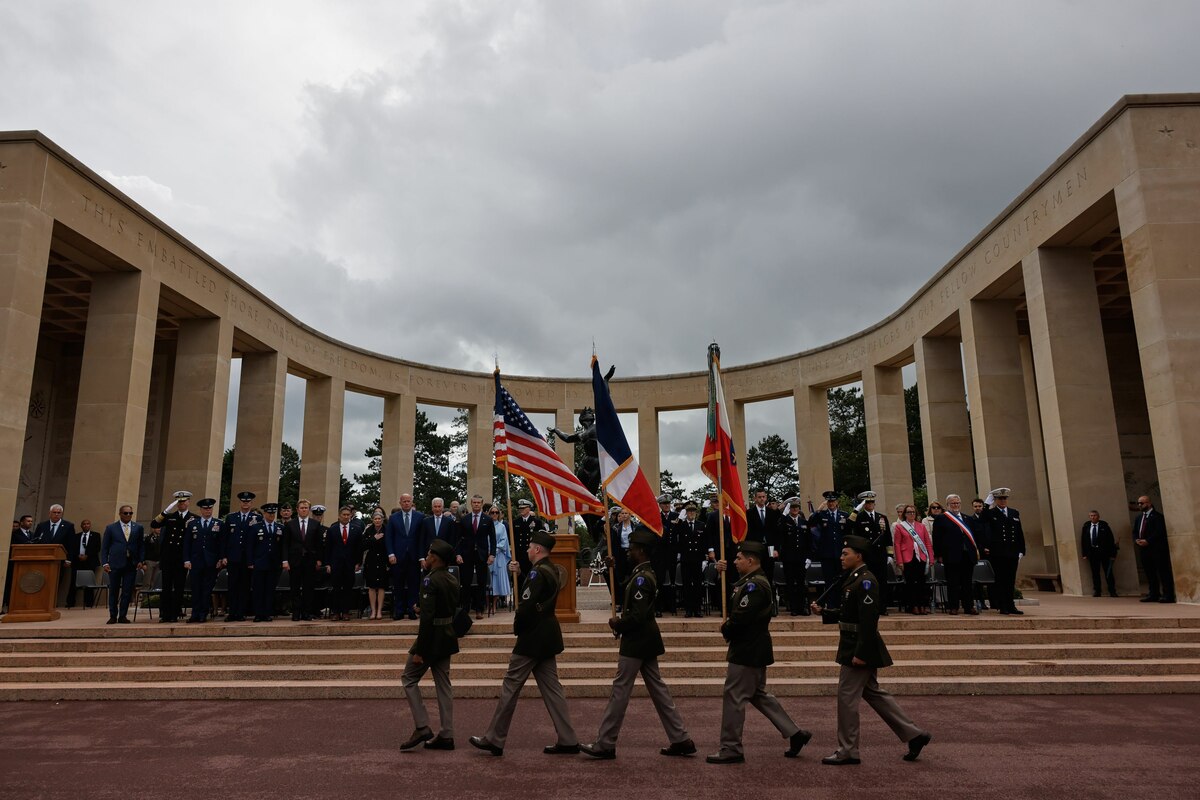
During a D-Day commemoration in Normandy, US Defense Secretary Pete Hegseth sparked controversy by equating contemporary migration to Europe with the 1944 Allied invasion, claiming migrants bring "dangerous ideologies" and questioning European leaders' response, drawing condemnation from US Democrats who accused him of politicizing the solemn event.
Imagine a grown-up from America, the defense boss, went to a very important historical event about brave soldiers who fought a long time ago. But instead of just talking about the old war, he started talking about people moving to Europe today, calling it an "invasion." Another important American grown-up from a different political team got very upset, saying it was wrong to use the memory of heroes for today's arguments.
Analysis
Hegseth's Provocative D-Day Speech
US Secretary of Defense Pete Hegseth delivered a controversial speech during the 82nd-anniversary commemoration of D-Day in Colleville-sur-Mer, France. He drew a parallel between the 1944 Allied landings in Normandy and current migration flows into Europe. Hegseth asserted that "people and ships carrying dangerous ideologies" are arriving on European beaches in Spain, Italy, Greece, and Bulgaria. He questioned the response of European capitals, asking, "When will European capitals do something about this invasion, or is it already too late?" He suggested that European allies still have an opportunity to change their course.
Democratic Condemnation
Hakeem Jeffries, the Democratic minority leader in the US House of Representatives, strongly criticized Hegseth's remarks. Jeffries stated on the X platform that "thousands of American heroes died on D-Day to defend freedom and defeat fascism. Pete Hegseth should honor and respect their memory." He warned against the political instrumentalization of such a significant historical commemoration. D-Day, on June 6, 1944, marked the pivotal beginning of the liberation of France and Western Europe from Nazi rule, with Allied forces primarily comprising Americans, Britons, Canadians, Poles, and French soldiers.
Broader Context of Trump Administration's Stance
The article notes that the Trump administration, which Hegseth is associated with, has consistently criticized its European allies over perceived threats from an "invasion" of immigrants. It has accused European nations of adopting misguided migration policies. Within the US, the Trump government has promoted a stringent approach to asylum seekers and undocumented migrants. This sentiment was echoed by Vice President JD Vance, who, in a recent X post, called for "righteous anger" and linked the murder of an 18-year-old in Southampton, England, to a supposed "mass invasion of migrants," prompting the British government to urge against "division, hatred or tensions."
Key points
- US Defense Secretary Pete Hegseth compared current European migration to the 1944 D-Day landings during a commemoration speech.
- Hegseth claimed migrants bring "dangerous ideologies" and questioned Europe's response to this "invasion."
- Democratic minority leader Hakeem Jeffries sharply criticized Hegseth for politicizing the D-Day commemoration.
- The Trump administration has previously criticized European allies over migration, and Vice President JD Vance also recently linked crime to "mass invasion of migrants."
The controversy might prompt a more constructive and respectful debate on migration policies in Europe, encouraging leaders to find solutions that address humanitarian concerns while ensuring security. It could also lead to a stronger emphasis on accurate historical remembrance, free from political manipulation.
Hegseth's provocative rhetoric risks further polarizing public opinion on migration, potentially fueling xenophobia and undermining international cooperation on refugee issues. Such comparisons could also degrade the solemnity of historical events like D-Day, making them battlegrounds for contemporary political debates.