FM spox: Diplomacy in full harmony with other pillars of Establishment
Iranian Foreign Ministry Spokesman Esmaeil Baghaei asserted that Iran's diplomacy aligns with national interests and supports its Armed Forces, while accusing the US of waging an economic war that targets nations' sovereignty and free trade.
Intelligence analysis by Gemini 2.5 Flash
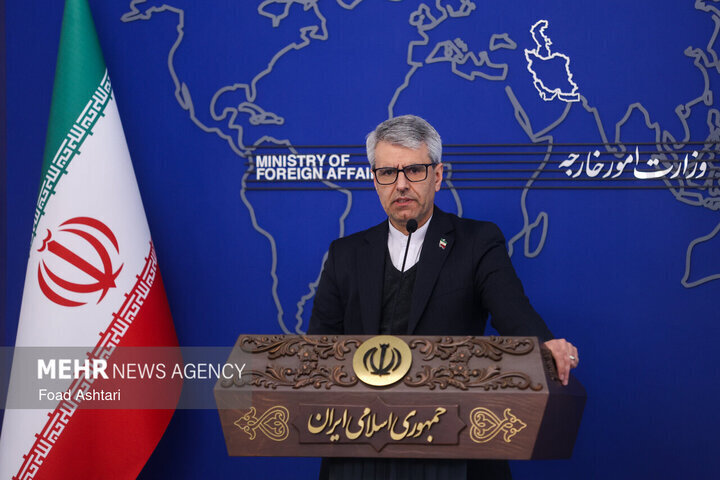
Baghaei, speaking at a press briefing, stated that the US must be held accountable for its aggression and war crimes against Iran, including an economic war and attacks on civilian vessels. He also criticized the US-European IAEA draft resolution as politicized and highlighted the ongoing Israeli "genocide" in Gaza, emphasizing diplomacy as a tool for national goals.
Imagine Iran and America are playing a tough game. Iran says America is playing unfairly by trying to hurt its economy, like blocking its trade, and even attacking its ships. Iran's spokesperson says their country's leaders are all working together to protect Iran and its people, and that talking (diplomacy) is just one way to do that. They also say that a big water path called the Strait of Hormuz is now dangerous because of America's actions, and that other countries are being unfair about Iran's nuclear energy plans.
Analysis
The Iranian Foreign Ministry's spokesman, Esmaeil Baghaei, articulated a comprehensive view of Iran's foreign policy, framing it as a unified effort across various state pillars. He strongly condemned the United States, asserting that its economic war against Iran extends beyond the nation itself, targeting the sovereignty of all nations and the principle of free trade. This perspective positions Iran as a defender of broader international norms against what it perceives as American unilateralism and coercive actions. Baghaei demanded accountability from the US for its alleged aggression and "war crimes" against the Iranian populace, including specific accusations of attacks on Iranian civilian vessels, which he labeled as acts of terror.
US Economic War
Iran views the ongoing economic pressures from the United States not merely as sanctions but as a full-scale "economic war" designed to undermine its national sovereignty. This framing suggests that the US is employing economic tools as a form of aggression, impacting not only Iran's economy but also its ability to engage in international commerce freely. The spokesman's remarks underscore a deep-seated grievance regarding the extraterritorial reach of US sanctions and their perceived impact on global trade mechanisms.
Furthermore, Baghaei linked these economic actions to a broader pattern of "coercive actions" by the US, demanding that Washington be held responsible for its alleged "aggression" and "war crimes" against the Iranian nation. This rhetoric aims to elevate the discourse beyond mere policy disagreements to a moral and legal indictment of US foreign policy. By highlighting attacks on civilian vessels, Iran seeks to portray itself as a victim of direct military and economic hostilities, reinforcing its narrative of resistance.
Strait of Hormuz
A significant point of contention raised by Baghaei concerned the safety and navigability of the Strait of Hormuz, a critical global chokepoint for oil shipments. He explicitly stated that the Strait has become "unsafe due to US attacks" and a "naval blockade against Iran." This accusation directly challenges the US narrative of ensuring freedom of navigation and implies that American military presence is a destabilizing rather than a security-providing factor in the region.
The Iranian spokesman's assertion that the Strait is unsafe due to US actions carries substantial implications for international maritime security and energy markets. By framing US activities as a "naval blockade," Iran suggests a direct infringement on its sovereign rights and international law, potentially justifying its own defensive measures. This perspective highlights the volatile nature of the region and the potential for escalation stemming from differing interpretations of international maritime conduct and national security interests.
Rafael Grossi
Baghaei also addressed the diplomatic efforts by the US and European countries to refer Iran's nuclear file to the UN Security Council, dismissing these attempts as "illegal." He specifically criticized the US-European anti-Iran IAEA draft resolution, stating it is "based on agency director's politicized report." This indicates Iran's deep distrust of the impartiality of international bodies when they are perceived to be influenced by Western powers.
The Iranian Foreign Ministry spokesman's comments regarding Rafael Grossi, the IAEA Chief, suggest a belief that the agency's reports are being manipulated to serve political agendas rather than objective technical assessments. Baghaei's statement that "Wherever they fall short, they [Western countries] turn to the IAEA and its chief" implies a pattern of using the IAEA as a tool for pressure when other diplomatic avenues fail. This stance reflects Iran's consistent position that its nuclear program is peaceful and that external pressures are politically motivated rather than genuinely concerned with non-proliferation.
Key points
- Iran's diplomacy is fully aligned with its national interests and supports its Armed Forces.
- The US economic war on Iran is seen as targeting national sovereignty and free trade, demanding US accountability for aggression and war crimes.
- US attacks on Iranian civilian vessels are labeled as acts of terror and war crimes.
- The Strait of Hormuz is considered unsafe due to US actions and a naval blockade against Iran.
- The US-European IAEA draft resolution on Iran's nuclear file is rejected as illegal and based on a politicized report by the IAEA chief.
- The Israeli regime's actions in Gaza and Lebanon are condemned as genocide and violations of sovereignty, enabled by US support and international inaction.
The article suggests that "Negotiation is a tool for advancing the country's goals," implying that despite current tensions, Iran remains open to diplomatic solutions if they serve its national interests. This could lead to de-escalation and a more stable regional environment if constructive dialogue is pursued by all parties.
The article highlights a "turbulent state" in the region, with ongoing "aggressions" and "war crimes" attributed to the US and Israel, alongside an "economic war" against Iran. This suggests a high risk of continued conflict, further destabilization, and potential escalation if these grievances are not addressed, leading to prolonged regional turmoil.
Market signals
- OIL The claim that the Strait of Hormuz is unsafe due to US actions and a naval blockade against Iran raises concerns about oil supply disruptions.
AI-generated analysis of potential market relevance. Not financial advice.