Why nearly three million Teslas are being recalled in China
Tesla is recalling 2.98 million vehicles in China over hidden door handles that are difficult to locate in emergencies, part of a broader 4-million-vehicle recall also hitting XPeng, Xiaomi and Geely.
Intelligence analysis by Llama
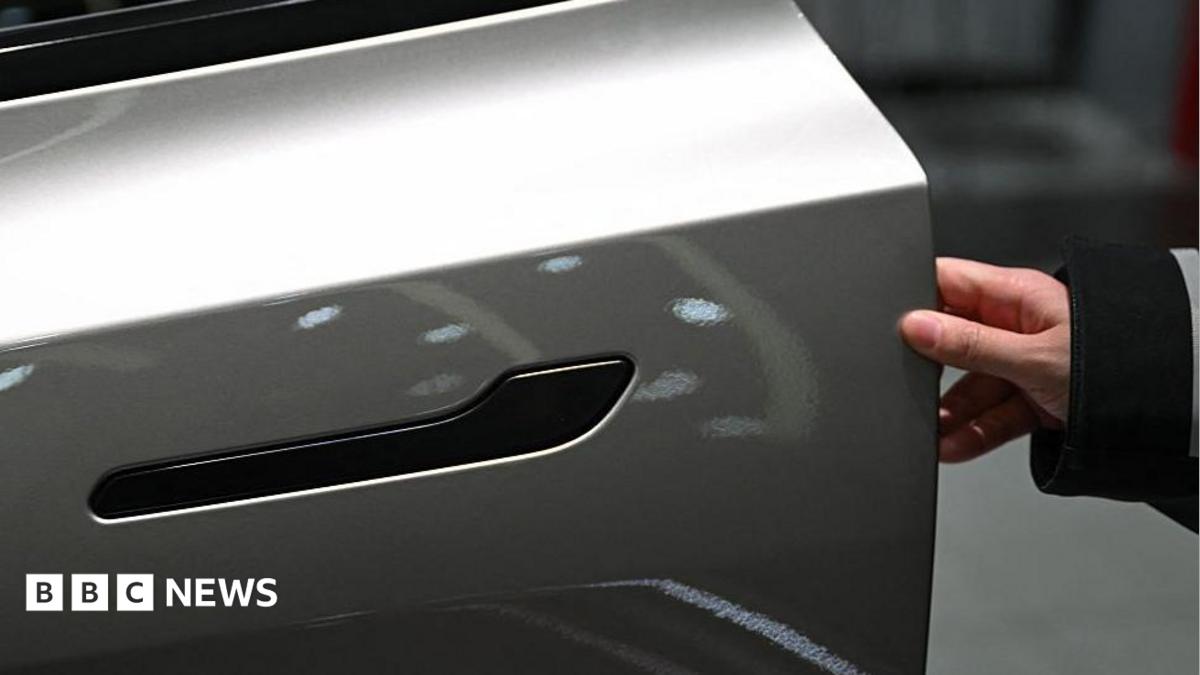
Chinese regulators have ordered the recall of more than 4 million EVs over hidden door handles, including 2.98 million Teslas, after fatal crashes raised safety concerns. Beijing had already announced a ban on the design effective 1 January 2027.
A car company has to fix almost 3 million cars in China because the door handles hide inside the door and people can't find them quickly in a crash. It's like if a toy's emergency stop button was hidden behind a secret panel — fine most of the time, but terrible when something goes wrong.
Analysis
2.98 million Teslas caught in China's sweeping door-handle clampdown
Tesla's recall covers its Model 3, Y, S and X vehicles assembled in China, according to the company's statement reported in the article. The carmaker acknowledged that its door handles are "difficult to identify and operate because their colour is similar to the interior trim," a problem that becomes acute when a "severe collision causing the vehicle's low-voltage system to fail" prevents electronic release. Tesla plans to add warning labels and a software update that automatically lowers windows after a collision, but the underlying mechanical vulnerability remains. That gap matters because it leaves Tesla racing to comply with forthcoming rules that explicitly require a physical release on both the inside and outside of every door.
The 1 January 2027 mechanical release requirement
Beijing's State Administration for Market Regulation announced in February that hidden door handles would be banned on cars sold in China starting 1 January 2027. Under the new rules, vehicles must have a mechanical release on both the inside and outside of their doors, addressing exactly the failure mode observed in the fatal Xiaomi crashes. The trigger for the regulatory shift was two fatal collisions involving Xiaomi EVs in China, where power failures were suspected to have prevented doors from being opened. With more than 4 million vehicles now caught in the recall net, including models from XPeng, Xiaomi and Geely, Chinese authorities have effectively turned what was once a design signature into a compliance liability.
Tu Le's "band-aid" verdict on Tesla's software fix
Tu Le, founder of consultancy Sino Auto Insights, called Tesla's combination of warning labels and a software update more of a "band-aid" than a lasting solution. His critique underlines a broader industry reckoning: the minimalist look pioneered by Tesla's Model S sedan since 2014 has been widely copied by Chinese brands chasing the same sleek aesthetic, and unwinding it will require hardware redesigns rather than firmware patches. The recall also follows scrutiny from the US National Highway Traffic Safety Administration, which in July suggested creating a new formal safety standard for all carmakers after reports of children being trapped in Tesla vehicles. The global dimension of the design trend means Beijing's 2027 rule could end up reshaping EV cabins far beyond China, even though the article notes it is not clear whether affected firms plan a similar recall elsewhere.
Key points
- Tesla is recalling 2.98 million Model 3, Y, S and X vehicles made in China over hidden door handles
- The recall is part of a broader action affecting more than 4 million EVs from XPeng, Xiaomi and Geely
- Two fatal Xiaomi EV crashes in China, where power failures may have trapped occupants, triggered the regulatory response
- Tesla plans warning labels and a software update that auto-lowers windows after collisions rather than a hardware fix
- China will ban hidden door handles on new cars from 1 January 2027, requiring mechanical releases on both sides
- US safety regulators are separately probing Tesla door handles after reports of children being trapped
If Tesla and the other affected automakers use the recall as a chance to redesign their door systems with clear mechanical releases ahead of the 2027 deadline, the episode could produce safer, more intuitive vehicles while preserving much of the sleek aesthetic. Compliance would also give the industry a harmonised template that reduces regulatory uncertainty going forward.
The "band-aid" software fix may fail to satisfy regulators or restore consumer confidence if another fatal incident occurs before mechanical redesigns reach the market. A fractured global response, with China enforcing strict rules while the US only probes the issue, could leave Tesla navigating two divergent safety regimes at once, raising compliance costs and complicating supply chains.
Market signals
- TSLA A recall covering 2.98 million Chinese-made Teslas imposes compliance costs and reputational risk, though the article does not quantify the financial impact.
AI-generated analysis of potential market relevance. Not financial advice.